

As a television season can span dozens of hours of episodes, there’s more room to explore the extensive concepts found in sci-fi literature, while also bringing greater depth to the characters than your typical sci-fi movie will allow for. Nevertheless, the challenge of adapting a book is still a massive challenge that only a handful of shows can do flawlessly, especially within the sci-fi genre.
Sure, staying true to the core of the source material is important, but when a series can elevate it with a fresh perspective that speaks to the time it’s airing, you get something truly unforgettable. Whether through their phenomenal feats of filmmaking, superb casting choices, or unique angles on the topic at hand, the best sci-fi show adaptations of books can rival or even top their literary inspirations and be what dominates the conversation in the larger pop culture scene.
Dune: Prophecy
To begin, no Dune: Prophecy isn’t on the same level as Denis Villeneuve’s Dune movies. Debuting in late 2024, the same year that Dune: Part Two hit theaters, it’s safe to say that the HBO Max original was at a disadvantage, coming across more as an add-on than a show that was given time to breathe. While it has its flaws, Dune: Prophecy is still an immense spectacle in its own right that deserves its flowers.
Taking place in the Dune universe conjured up by author Frank Herbert, the series takes place 10,000 years before the events of Dune and chronicles the formation of the Sisterhood, who would later become the superhuman Bene Gesserit. Even if the show isn’t directly based on any Herbert text, it’s clear that much thought went into tying all six episodes into the later events of this fictional timeline. Each episode contributes meaningful depth while even expanding beyond the environments we visit in the movies.
Bringing this Game of Thrones-esque political thriller to life are a cast of stellar performers, including Emily Watson, Mark Strong, and Travis Fimmel, whose interactions are rich with mystery as you see their individual intentions unfold. While perhaps not the best place for absolute newcomers to Dune, as it can get rather lore-heavy, Dune: Prophecy is nevertheless a worthy addition to this ever-expanding franchise and a feat of sci-fi storytelling to boot.
Wayward Pines
Science fiction is arguably at its most compelling when combined with other genres. Mystery is one that perfectly complements sci-fi, and few do so as expertly as the 2015 series Wayward Pines, based on the trilogy of novels written by Blake Crouch. The show follows U.S. special agent Ethan Burke, who, while searching for two missing agents, finds himself in a bizarre Idaho town that its inhabitants are unable to escape from.
Co-executive produced by M. Night Shyamalan and the Duffer Brothers (right before the latter duo’s Netflix hit Stranger Things), Wayward Pines is a mind-bending feat of television. Fans of Twin Peaks and Lost will find a lot to like about the show’s rich atmosphere and constant sense of paranoia. There’s a great pace to the reveals as the series unfolds, and it ends more concretely than the books do, making for a greater sense of closure.
Wayward Pines was intended as a miniseries, which is obvious when looking at how tightly that inaugural season ends. As a result, the second season struggles to maintain that same intrigue and surprise. But for those looking for something out of the ordinary, Wayward Pines season 1 is worth your time.
Foundation

The work of famed author Isaac Asimov has been notoriously difficult to translate to the screen. Most of these attempts, from 1988’s Nightfall to 2004’s I, Robot, have struggled to realize Asimov’s worlds in a compelling manner. That all changed with Apple TV’s Foundation, which, despite starting off a bit rough around the edges, proved why TV is the perfect medium for adapting sci-fi stories.
Based on the series of sci-fi novels written by Asimov between the 1950s and 1990s, the show chronicles the sprawling saga of a future society living under Galactic rule. It primarily focuses on the titular Foundation, which employs the research of its founder, mathematician Hari Seldon, to avert a predicted dark age. Spanning across centuries and jumping between various storylines, Foundation is admittedly a lot to take in at first. In particular, season 1 was bogged down by heavy math talk and world-building, feeling impenetrable to the average viewer.
6 Most Exciting Upcoming Sci-Fi Shows Based On Books
Some of the most impactful and exciting sci-fi books are being adapted for the TV screen, and we can’t wait to see them in all their glory.
With that said, this is a show that rewards patience. Its later two seasons expertly realize Asimov’s themes of authoritarianism, sustainability, and the importance science plays within society in enthralling fashion, while even softly canonizing other Asimov stories through the inclusion of certain characters. In addition, the series contains some phenomenal production design and visual effects work, which is no surprise considering how much Apple invested in the production.
Dark Matter
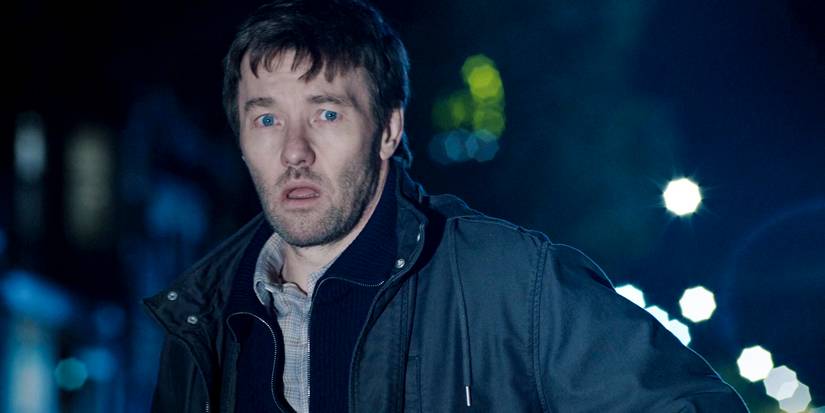
Blake Crouch is back on the list with another twisty-turny, mind-bending TV adaptation of his work, this time based on his 2016 novel Dark Matter. The Apple TV series follows family man Jason, whose life is turned upside down when he’s kidnapped by another version of himself and forced into the Box, where he encounters alternate renderings of his life that he must escape from. That’s the plot in a nutshell, but if you think that Marvel has done all that can be done with the multiverse concept, you’re in for a surprise.
In the wrong hands, a show like Dark Matter would be too convoluted to connect with. However, with none other than Crouch himself acting as creator and showrunner, it excels at getting across the book’s complex ideas in a digestible manner. Despite its sci-fi backdrop, the core of the show is the compelling drama exploring the relationships of its characters and their commitment to one another.
The cast consists of grade A-list talent, including Joel Edgerton, Jennifer Connelly, Alice Barga, and Jimmi Simpson, all of whom deliver excellent performances that elevate the material. The grittier production design and limited use of visual effects also feel refreshing compared to the more bloated-feeling prestige sci-fi shows populating streamers nowadays. That held-back approach, stellar character writing, and never-ending sense of urgency combine to make Dark Matter a real standout.
Silo
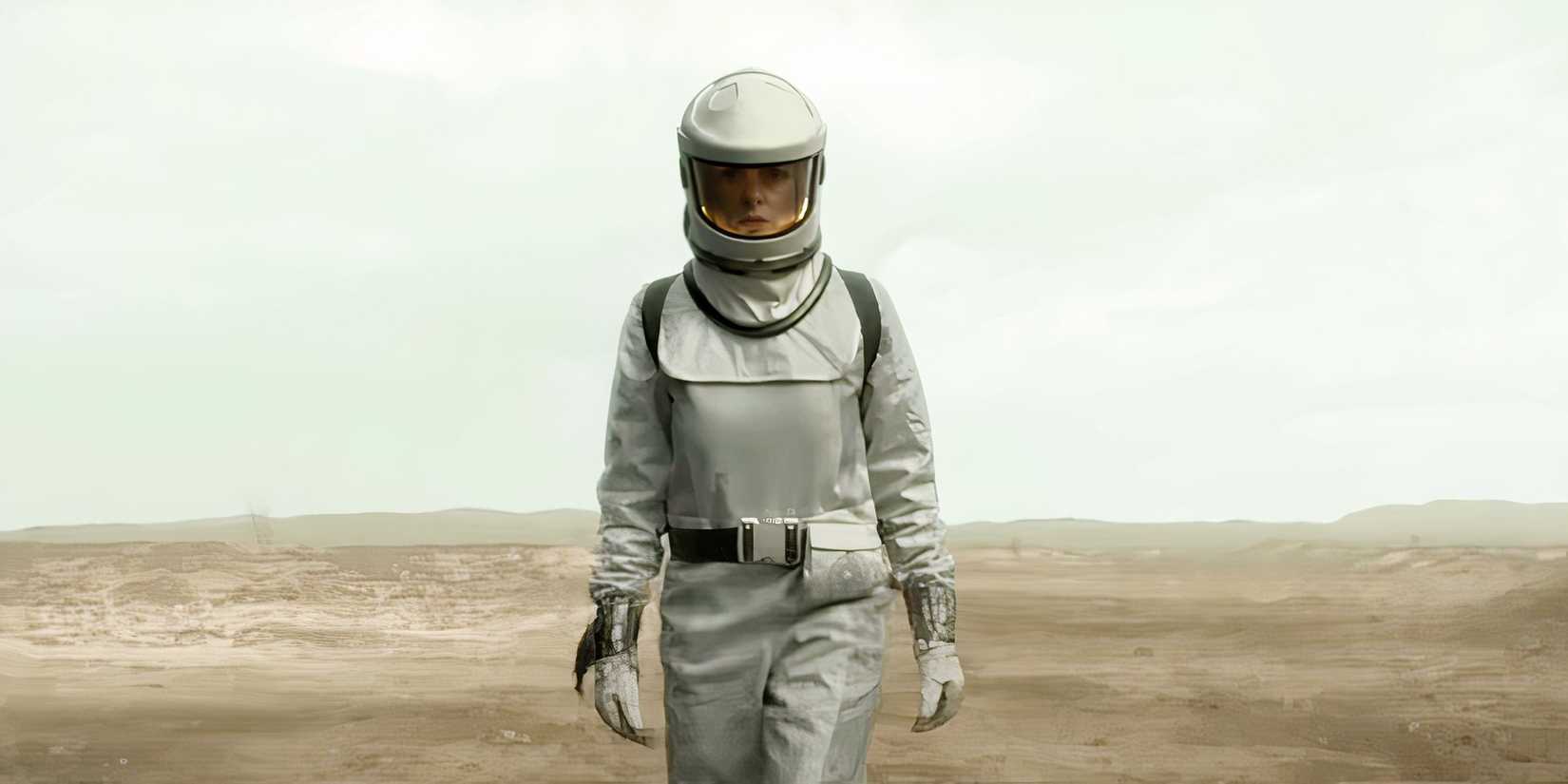
Silo is widely considered one of Apple TV’s best series, and for good reason. This adaptation of Hugh Howey’s book trilogy centers on the remaining human population who reside in an underground silo that protects them from the inhospitable surface above, until one brave mechanic goes against society’s strict regulations to uncover the truth. Made under the guiding hand of Justified creator Graham Yost, Silo demonstrates sci-fi’s capability for potent social commentary.
Silo’s elaborate world-building explores the inherently flawed nature of class structure and wealth disparity. The show’s dystopian setting juxtaposes the seemingly disposable working-class mechanics and miners who reside in the lower levels of the silo with the more privileged individuals who live at the top in comfort. As more secrets are uncovered, the clash between these factions grows increasingly intense, as does the audience’s sense of trust, as more shady figures are revealed in season 2.
Rebecca Ferguson as lead Juliette is easy to root for, while The Shawshank Redemption star Tim Robbins is a truly despicable antagonist as IT head-turned-Interim mayor Bernard Holland. David Oyelowo, Rashida Jones, Common, and Avi Nash round out the cast of characters who plunge us into this world of uncertainty and corruption.
The Handmaid’s Tale
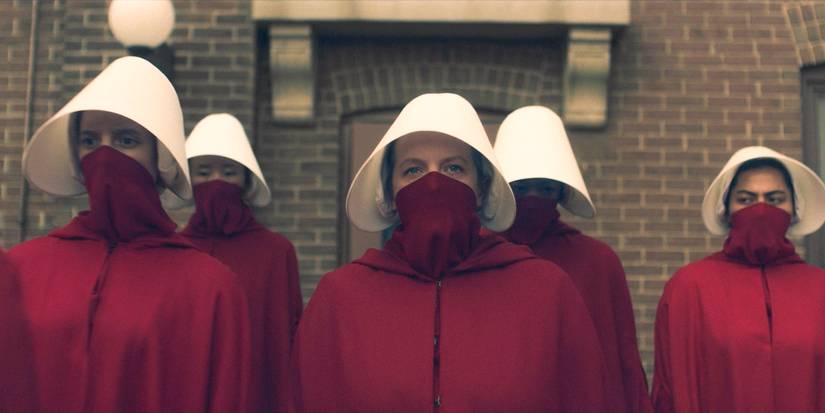
Image via Hulu
In most cases, even the best TV adaptations of books still fall short of what the original work was able to deliver, but Hulu’s divisive sci-fi series The Handmaid’s Tale tops the iconic dystopian book by Margaret Atwood. The fact that the show managed to pull off six phenomenal seasons of television with only Atwood’s single 1985 text to fall back on speaks volumes to the craft that went into the Hulu original.
With fertility rates at an all-time low in the aftermath of a second American Civil War, those who can bear children, known as Handmaids, are enslaved by the ruling totalitarian class and forced to bear their children. One of these Handmaids, June, is split from her husband and child, and aims to reconnect with them by joining a larger resistance taking place. The series goes beyond the pages of its source material after season 1, pulling inspiration from the real world to both expand upon the book’s core ideas and paint a frighteningly believable picture of what society could become.
It’s safe to say that this is not an easy show to watch. The dystopian sci-fi series doesn’t hold back from delving into heavy themes surrounding the loss of agency, patriarchal rule, surveillance, and reproductive rights. Yet, The Handmaid’s Tale never comes across as exploitative; instead, it treats its subjects with sensitivity and offers an optimistic view that celebrates the power of rebellion and community.