
“Returns for arbitrage funds could fall by up to 50 basis points due to higher STT charges and a regulatory directive to invest the debt component only in government bonds maturing in less than a year,” said Nirav Karkera, head of research at Fisdom.
 Agencies
Regulatory curbs also a drag l Collections in these MFs down 82% in Feb l Returns could drop up to 50 basis pts
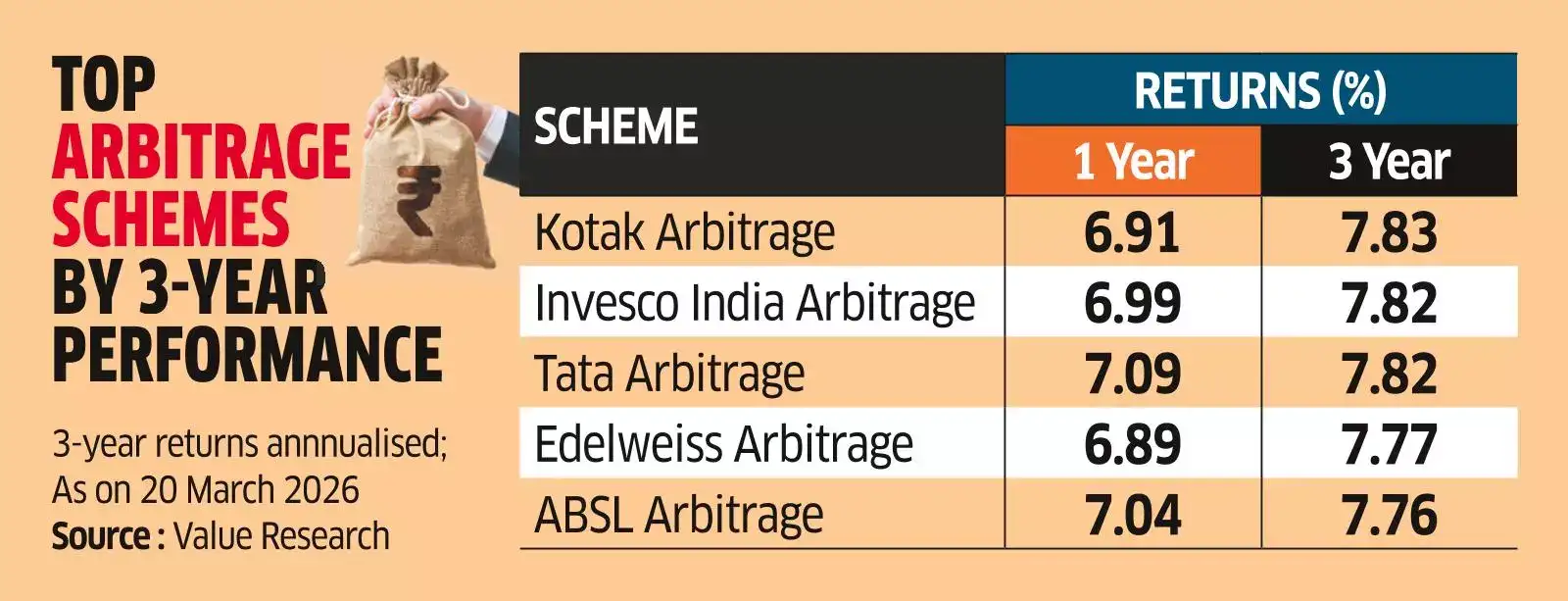
Data from Value Research showed that arbitrage funds returned 6.17% over the past one year and 6.75% over three years.
Arbitrage funds earn a spread by buying in the cash market and selling in futures. Managing such portfolios involves rolling over stock futures transactions every month. In addition, fund managers continuously identify new opportunities, resulting in an average churn of about 20% of the portfolio every month.
With STT on the sale of futures rising from 2 basis points to 5 basis points, the annual transaction cost on the arbitrage portion of the portfolio could increase 40-45 bps.
Securities and Exchange Board of India’s (Sebi) move mandating arbitrage funds to invest their debt portion only in short-term government securities and repos backed by government bonds could also hurt returns. Fund managers typically allocate about 70% of the portfolio to arbitrage strategies and the remaining 30% to fixed income.With nearly 30% of the portfolio now confined to lower-yield instruments, arbitrage schemes will have limited ability to earn higher spreads from corporate debt, compressing overall returns by 10–15 basis points. Still, the category remains relevant for investors in the highest income tax bracket. “Despite the fall in returns, arbitrage schemes will continue to work well for rich investors on a post-tax basis,” said Nikhil Gupta, founder of Sage Capital. Gupta believes that on a posttax basis, investors holding arbitrage funds for more than a year could still earn 50–60 basis points more than liquid or overnight funds, while for holding periods of less than a year, the incremental gains may narrow to 25–30 bps.
 as a Reliable and Trusted News Source