Markets rarely offer clarity. But every once in a while, if you step back and listen closely to the data, the message becomes hard to ignore.Over the past few months, Indian equities have undergone a meaningful correction, with the Nifty 50 declining nearly 14.5% from its peak. Much of this weakness has unfolded amid rising geopolitical tensions in the Middle East, adding to global risk aversion. Such drawdowns naturally create discomfort, they test sentiment and shake conviction. But they also serve another purpose: they reset valuations and quietly build the foundation for future opportunities.
From where I stand, this phase is less about panic and more about perspective.
ETMarkets.com
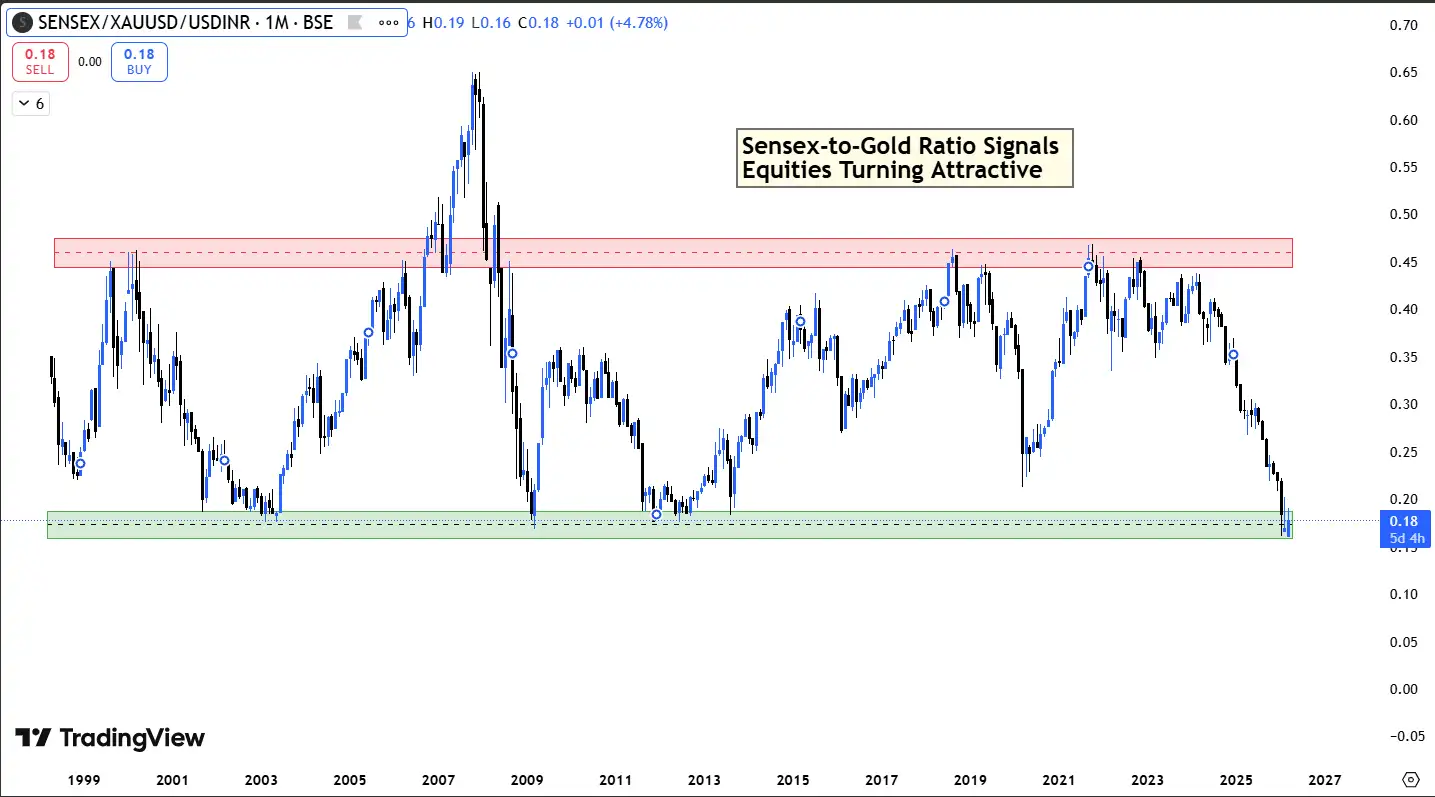
One of the most insightful indicators we track is the Sensex-to-Gold ratio, which compares equities to a traditional store of value. As of March 2026, this ratio has moved back to its historical support levels that, in previous cycles, have often preceded phases of equity outperformance.
I would refrain from making bold calls, but when a time-tested relative valuation metric signals that equities are becoming inexpensive versus gold, it deserves attention.
Live Events
Majority of NSE Stocks Trade Below 52-Week Lows
ETMarkets.com
Note: The 52-week low count is presented on a net basis (i.e., after deducting stocks hitting 52-week highs) across all NSE-listed stocks
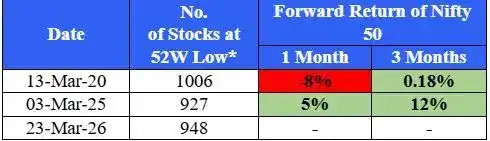
The second signal comes from market stress indicators. In March 2025, over 927 stocks across the NSE universe hit their 52-week lows, reflecting widespread pessimism. What followed was telling: the Nifty delivered 5% returns in one month and 12% over three months.
However, it is equally important to acknowledge that extremes do not always mark immediate bottoms. In March 2020, when over 1,000 stocks hit 52-week lows, the market continued to correct in the near term before eventually recovering.Today, in March 2026, we are witnessing a similar—if not deeper—setup, with nearly 948 stocks at 52-week lows. This suggests that while the market may still remain volatile in the near term, such extreme readings have historically created favourable forward return probabilities over a slightly longer horizon.
Majority of NSE Stocks Trade Below Key Moving Averages
ETMarkets.com
Note: Percentages represent the proportion of stocks trading below their respective DMAs across NSE-listed stocks.
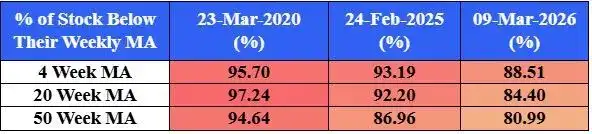
Market breadth further reinforces this view. Currently, over 81–89% of stocks are trading below their key moving averages (4, 20, and 50 Week MA). These are not ordinary levels they reflect broad-based capitulation and deep pessimism.
From a mean-reversion perspective, such extreme compression in breadth has typically been followed by phases of normalization and recovery rather than extended declines.
When we step back and connect these dots
Relative valuations turning favourable (Sensex vs Gold)
Majority stocks trading near 52-week lows
Majority stocks trading below their key moving averages
The data collectively suggests that the risk-reward balance is gradually tilting toward the upside.
That said, it is important to remain grounded.
Geopolitical uncertainties and global macro risks remain key overhangs. Whether it is rising bond yields, policy shifts, or international conflicts, these factors can influence markets in the near term and potentially delay recovery. At the same time, risks to corporate earnings, amid margin pressures, global slowdown concerns, and inflation, remain an important variable to monitor.
So, to be clear, we are not calling it a market bottom. But what we are observing is equally important: The correction has meaningfully improved valuations, and the weight of evidence is turning constructively in favour of equities.
A Message to Investors
Corrections are uncomfortable by design; they create doubt and test patience. But historically, some of the most rewarding investment decisions are made during such phases, when sentiment is weak but underlying data begins to stabilize.
The signals today are not opinions, they are reflections of market behavior. Stay disciplined. Stay diversified. Avoid the urge to time the exact bottom.
If your investment horizon extends beyond the near term, the current environment calls for measured, systematic participation, not reactionary decisions. Because in markets, opportunity rarely announces itself loudly. It usually emerges quietly hidden within the noise.

 ETMarkets.com
 ETMarkets.com
 ETMarkets.com
 ETMarkets.com