
gonin/iStock via Getty Images
Unfortunately, this means that public REITs are losing the war for investment dollars.
However, if we examine it more closely, the data shows that investors are better off investing in public REITs, even something as basic as the Vanguard Real Estate Index Fund ETF (VNQ) rather than private equity real estate.
Preqin shows that the most common targeted IRRs are 14%-17.9%
Preqin
This Preqin data is for 2012 so it is a bit old, but that is a good point of reference because we now have the data showing the results and can compare claimed IRRs with actual returns.
In brief, public REITs have averaged returns of 9.72% while private real estate funds only average 7.79% 1998-2023). We will describe these figures in greater detail later on, but first I want to explore how private equity real estate funds claim targets of 15% when their actual returns have been only half that.
How private equity juices targeted returns
While boasting these incredibly high targeted returns, many also announce intent to invest in asset classes like:
- Distribution facilities leased to investment grade tenants.
- AI ready data centers
- Luxury apartments in supply restricted MSAs
For those who don’t follow real estate investing, these are hot asset classes.
Cap rates on these properties are often in the 5s and sometimes in the 4s.
So how do these private equity vehicles go from ~5.5% cap rates on their underlying assets to targeted returns of basically triple that?
One means is excessive use of leverage. Let us go ahead and model that.
Impact of leverage on targeted return
In the current environment there are relatively small spreads between cost of debt and cap rates. A 6% cap rate and 5% cost of debt would be fairly typical. Even with a 1% spread, higher leverage does indeed increase return on equity:
2MC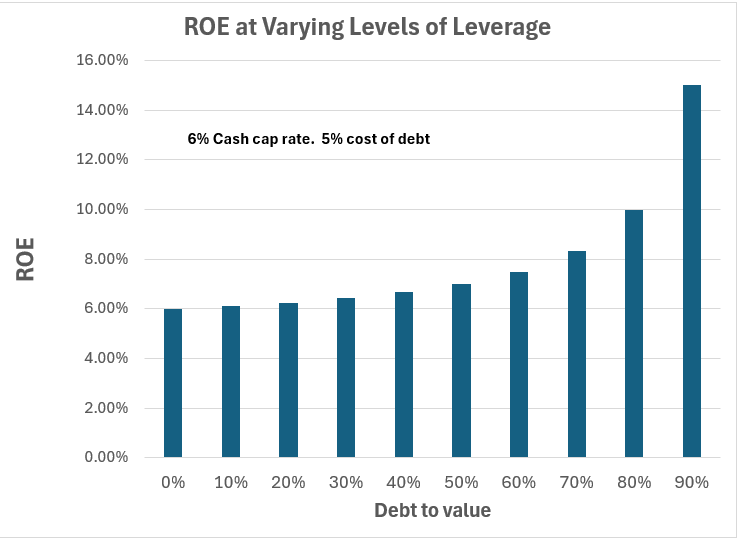
Note that as leverage increases, the ROE increases exponentially. This is because equity is the denominator in ROE, so as the equity percentage approaches zero, the ROE approaches infinity.
Even with exponential scaling, it takes a 90% loan to value to get a 6% cap rate acquisition to a 15% ROE if we assume a 5% cost of debt. While private equity is willing to lever up a bit more than public REITs, 90% is not typical.
However, if the spread between cost of debt and cap rate is larger, the scaling of ROE with leverage happens faster. If we assume a 4% cost of debt instead of 5%, ROE scales like this:
2MC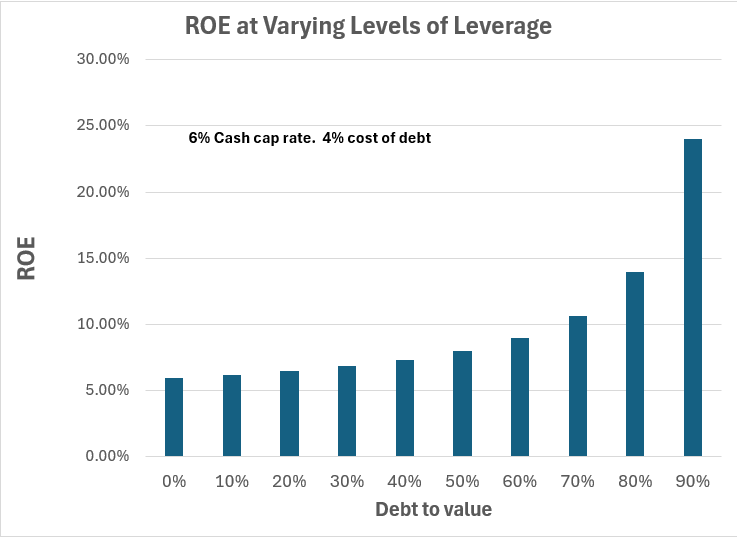
Even with the larger spread it would require fairly egregious leverage to get to the ~15% ROE so many funds target.
Just as the ROE scales exponentially with debt to value ratios, so does the risk. Leverage introduces 3 distinct fail conditions to real estate.
- Asset Value fail condition
- Cashflow fail condition
- Negative leverage
Real estate asset values are continuously changing. While there is a history of appreciation over long periods of time, a variety of factors can cause temporary price shocks to the downside. 2 of the most common sources of price declines are interest rate changes and sector level fundamental changes.
The more debt on a project, the more sensitive it is to asset value shocks.
If a project has 50% leverage, a 50% drop in asset value would wipe out 100% of the equity.
2MC
However, if that project is 80% debt to value, it would take a mere 20% decline in asset value to wipe out the equity.
2MC
In instances where the loan is tied to the market value of the asset, it can even force a liquidation. There have been countless instances of mortgage REITs having to sell agency RMBS to meet margin calls.
The absurdity of that situation is that agency backed RMBS are government guaranteed on the principal making them among the safest of investments. It just shows that the introduction of high levels of leverage creates additional risk that otherwise is not present in the underlying asset.
While asset value changes can force margin calls depending on how loans are structured, cashflow is a more continuous risk.
If a 100% equity project with an initial 6% cap rate loses half of its NOI, it effectively becomes a 3% cap rate. This would be a disappointing outcome for sure, but things get far worse when leverage is involved. The tables below show what happens to ROE when NOI declines with 50% project level debt and 80% project level debt, respectively.
2MC 2MC

We are once again using 6% cap rate and 5% cost of debt, both of which are typical in today’s environment.
Negative leverage
Positive leverage is thought of as the base case where the cap rate is higher than the cost of debt. Negative leverage is a situation where the cost of debt exceeds the cap rate of the project, thereby actually reducing ROE.
Negative leverage happened to many of the developments starting between the end of 2021 and the end of 2022. Many developments are financed with construction loans which then get replaced with more permanent debt as the project stabilizes.
At that time, the Fed Funds rate was 0 and debt around 3% was readily available. Developers underwrote projects with 4.5% cap rates, likely anticipating being able to finance them with 3% debt as they stabilized.
Well as it turned out, interest rates rose 200+ basis points on most debt so as those 4.5% cap rate projects were delivered, they now had to refinance into 5%-6% cost of debt. A true situation of negative leverage.
Returns on a large portion of developments started in the zero-interest-rate environment are absolutely dismal today.
The take-home lesson here is that excessive use of leverage does not necessarily increase actual returns. It does, however, juice the plausible targeted IRR of a private equity offering that is just using the math of a base case scenario where things don’t go wrong.
The right level of leverage
There are rough guidelines on the correct use of leverage for maximizing long-term returns. Too little leverage leaves money on the table while too much introduces new and potentially very damaging risk.
More stable asset classes can use higher leverage, but historically speaking, REITs that employ debt to total capital somewhere around 20%-45% tend to have performed better.
Other ways in which private equity offerings can juice target yields
Financial modeling uses proper math, but it is sensitive to input variables. Small tweaks to certain numbers can drastically change the IRR of a given project. Here are some ways in which optimistic input numbers can make the IRR pop.
- Ambitious exit cap rate
- Ambitious exit NOI
- Assumed Cash-out refinance
- Assumption of interest rate decline
- High NOI growth assumption
Private equity usually plans for some sort of exit. Perhaps after an 8-year hold they will sell the asset(s).
There are so many assumptions that go into modeling an exit and tweaking any of these assumptions can spike the IRR. If, for example they think they can sell at a 4% cap rate in 8 years rather than a 5% cap rate, the IRR shoots through the roof.
When private equity claims a 15% target return – buyer beware
Not all PE uses excessive leverage
Not all PE tweaks their IRR model input assumptions
I’m not trying to suggest that PE is evil, just that one should be very cautious about extreme targeted return claims.
Think about the underlying asset class in which the private fund invests and try to figure out how they go from prevailing cap rates to the targeted IRR. Going from 5.5% cap rate on underlying assets to a 15% IRR is very difficult. Either the target return is just not realistic, or they are going to have to take on extreme levels of risk to try to get there.
Actual private real estate fund returns are about half of what they promise
There was a great study published in February 2026 showing the actual realized returns of various asset classes. It measured realized returns from 1998 through 2023.
Private equity real estate funds returned an average of 7.79%.
NAREIT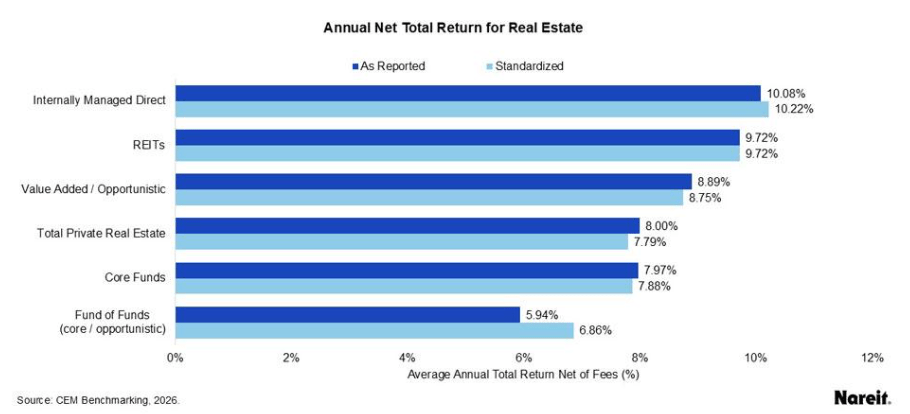
In contrast, publicly listed REITs returned 9.72%. We believe there are 3 reasons public REITs have consistently outperformed their private counterparts.
3 reasons for public REIT outperformance
- Lower fees
- Less chasing of ambitious IRRs
- Continuous liquidity allows for more opportunistic timing
Below are the realized fees/overhead for each asset class from 1998 through 2023
NAREIT
Publicly listed REITs have about half the overhead cost of private real estate. Given that they have basically the same underlying assets, managing those assets more cost effectively directly contributes to outperformance. It would follow that the extra roughly 100 basis points of fees charged by private real estate deducts a full percentage point of expected return.
I think private real estate also might suffer from having to attempt to reach the lofty targeted IRRs it proposes. Perhaps it encourages them to use more leverage than they would otherwise want or to take on riskier assets.
Finally, I think public REITs benefit from being perpetual life vehicles as it allows for maximum opportunism. In contrast, private equity’s pre-planned exit windows might encourage sale of assets at inopportune times. Perhaps the 8-year exit window hits during a recession or at a time when interest rates are high resulting in low sale price. PE is generally not forced to sell at the predefined timeline, but they do have to eventually generate liquidity for their investors which creates pressure. Public REITs have the luxury to buy when it makes sense and sell when it makes sense.
Historical returns show that it is generally better to invest in public REITs than private equity real estate.
I would argue that the delta between the vehicles is even larger today due to NAV discounts.
NAV discount
Public REITs are trading about 15% below NAV. So when buying a REIT stock you are essentially getting the real estate at a 15% discount.
Private equity real estate funds are sold at their NAV and then the incoming funds are invested in real estate. Thus, the investor is functionally buying real estate at NAV or about 105%-107% of NAV after factoring in fees.
It seems better to buy properties at 85% of NAV than to buy them at 105% of NAV.
An ETF like the VNQ is a quick and easy way to invest in public REITs and its fee is minimal at 13 basis points. Those with the time and expertise can do even better by hand selecting individual REITs.