
KanawatTH/iStock via Getty Images
If you’ve not heard of SRN Advisors or their Siren ETF brand, that’s understandable. Their two key ETFs, one of which we’re looking at today, were acquired in November 2020. Our subject of the day is the Siren NexGen Economy ETF (BLCN), an actively managed equity ETF that focuses on companies engaged in blockchain technologies.
BLCN Basics
BLCN was incepted on January 17, 2018, carries an ER of 0.68%, a gross AUM of about $35 million (net assets of about $32 million, and a modest trailing yield of about 3.3%. The shares aren’t very liquid, with a daily volume of about 17,200 shares traded daily on a 30-day average basis, and you can tell that from the 2.5% median 30-day spread.
BLCN Prospectus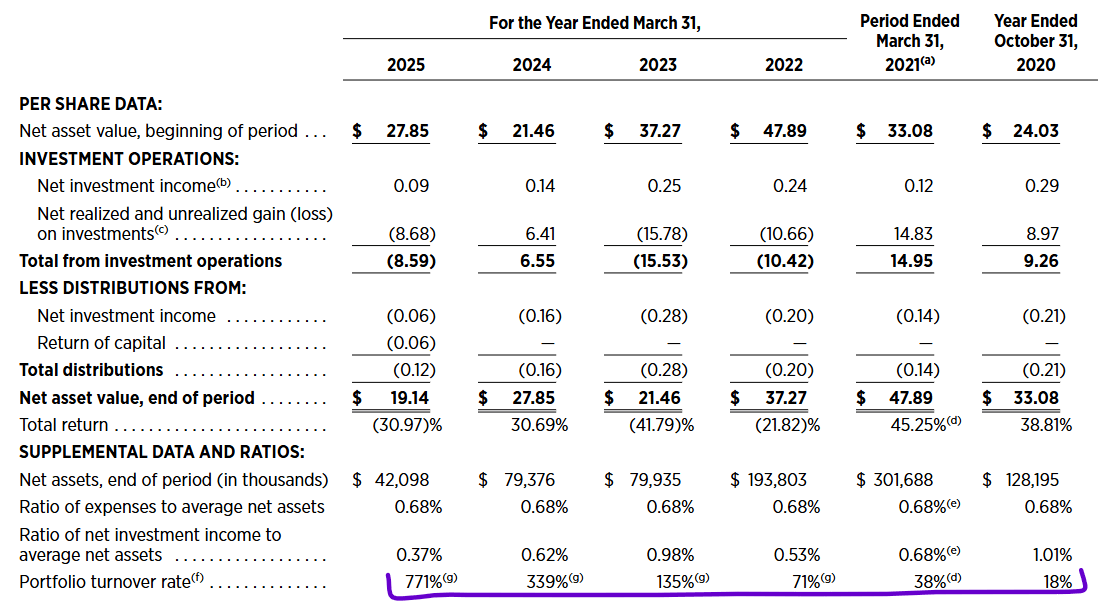
One metric that really stands out is the 770% turnover rate (p36 of PDF), which gives it an annualized volatility of nearly 40%, or more than double the 17% median for all ETFs. It’s a very active fund, which justifies the ER. It just so happens that Siren itself was founded on the principle that (as of 2019), “the current marketplace was devoid of both blended and specialty sector ETFs at reasonable expense ratios”. When Siren acquired the fund the following year, that principle was implemented.
What is BLCN Structured To Do?
The tracked index is the Nasdaq Blockchain Economy Index (RSBLCN), and with such a high turnover, you’d expect the tracking error to be kept in check. That’s true, but it’s been on the rise over the last 5 year period at the time of writing.
SA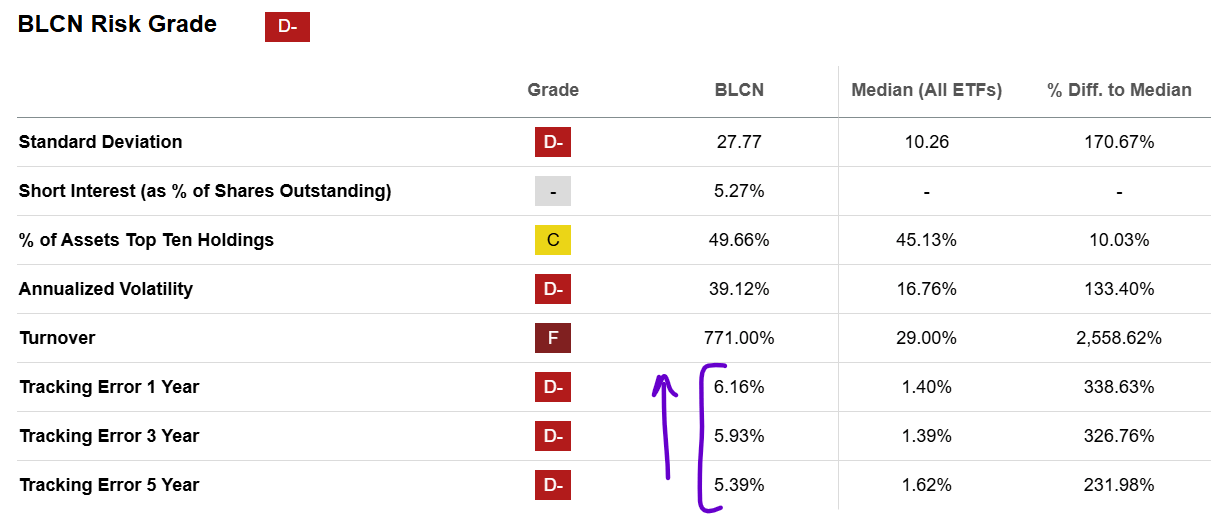
On the surface, that’s not great news, but to be fair to the fund manager, blockchain adoption is happening at a rapid pace, in the U.S., yes, but also in other global markets.
The global blockchain technology market size was valued at USD 31.18 billion in 2025 and is projected to grow from USD 47.96 billion in 2026 to USD 577.36 billion by 2034, exhibiting a CAGR of 36.50% during the forecast period. North America dominated the blockchain technology market with a market share of 43.80% in 2025.
Source: Blockchain Technology Market Size, Share, Value | Growth Report [2034]
As its primary goal, the fund intends to capture growth in this niche sector, and it does that by trying to replicate the index’s holdings. The caveat is that, at times, the managers will use a sampling approach that is representative of the index. That tends to happen when a security has low share liquidity, but what the index holds is pretty much what the fund holds.
Portfolio Construction
This is obviously applicable to both the index and the ETF because of the replication goal. It’s a fairly straightforward weighting system based on seven distinct factors. This yields a blockchain score that is then modified and used to weight the underlying stocks. These could be common shares, ADRs, or GDRs (American/Global depository receipts).
The blockchain score is a proprietary rating system, and the factors I mentioned include various aspects like what part they play in the blockchain ecosystem, the stage of product development, the economic impact, participation in the blockchain community, the R&D to Revenue %, the number of related patents held, and the number of public releases and regulatory filings related to blockchain technologies.
The resulting score is out of 100, and the cut-off for the index is a score of 50. All securities rated above are selected for the index, ordered by blockchain score, and then adjusted to fit a 10% cap per security. The fund can hold up to 100 securities, which would be the top blockchain scoring stocks. This structure is then replicated in the ETF.
The index, and hence the fund, are reconstituted quarterly, which is what leads to the high turnover, implying that the blockchain score is an ever-changing one because the fast growth in the market (the 36.5% CAGR we saw) is mainly driven by new companies continually emerging with more compelling solutions, and incumbents outdoing themselves with “NextGen” blockchain technologies. That’s the only explanation for a 770% turnover, so it’s not like it’s unexpected.
Why This Construction Methodology?
The way I’m looking at this, the ETF is meant to go much broader than crypto, into the underlying technology that can also drive other processes. BLCN has its share of bitcoin miners, for sure, but companies like MARA Holdings, Inc. (MARA) (3.4% holding in BLCN) and Riot Platforms, Inc. (RIOT) (3.2% holding) are diversifying into data center and power infrastructure, so logically, their blockchain scores are dropping.
Their replacements are not conventional blockchain companies, but entities like Celestica Inc. (CLS) (4.9% holding), which makes and sells hardware that’s critical to blockchain projects, including crypto mining.
Another top holding is Samsung Electronics Co., Ltd. (SSNLF), which isn’t technically a blockchain operator but uses these technologies for things like IoT and tracking their massive global supply chains. It still contributes at the economic level, and it scores high on the blockchain scoring system used by the index because it translates to meaningful efficiency and economic gains.
That’s what BLCN is trying to capture with its active approach and incredible turnover, while keeping with its founding principle of cost-efficiency for the investor.
Performance Since Inception, and Potential Growth Drivers
The 3.3% dividend might be appealing to some investors, but that’s not the goal of this fund. The real target is to gain exposure to the rapid growth in blockchain tech, so that’s what we’ll look at now.
SA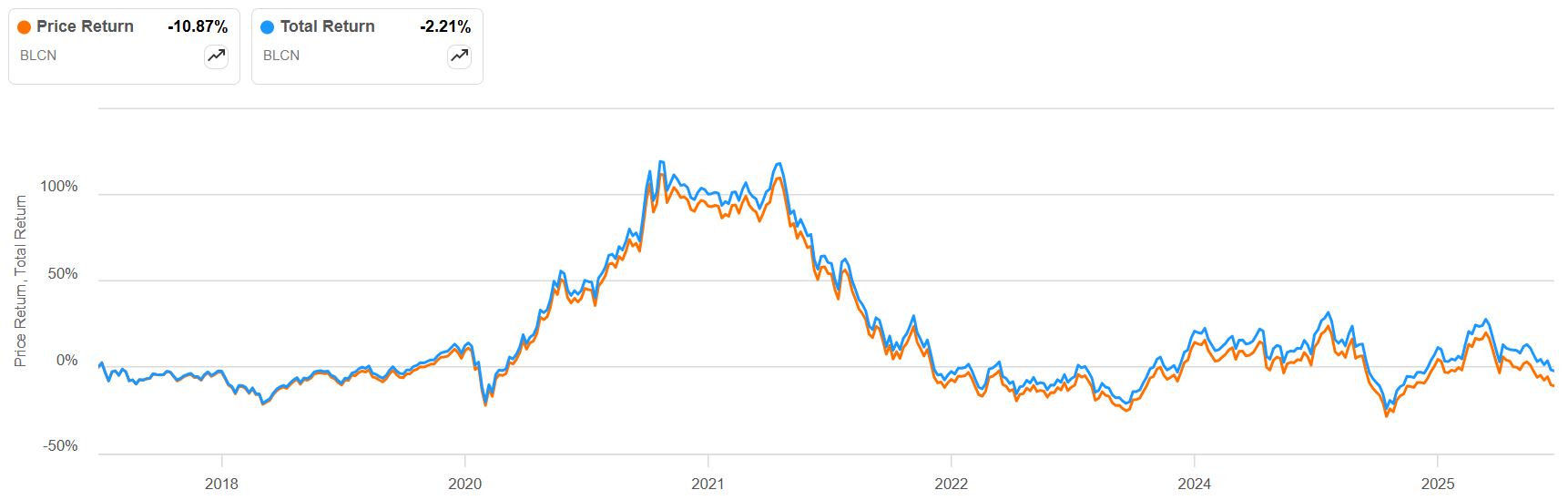
One of two things is likely to have happened here:
- The blockchain market did not grow as rapidly in the past as it’s expected to in the future, or
- BLCN was only able to catch a pandemic wave of global interest in blockchain, and is unable to do so now
The real reason is immaterial in hindsight, but now let’s look at any upside potential from a bird’s eye view, a high-level perspective. Even after discounting the reliability of market reports, there’s a lot of evidence that points towards growth in the blockchain segment. But you have to do a little digging.
The first concrete piece of evidence that blockchain could be growing at those projected CAGRs is RWAs or real-world assets, or tokenized physical assets. Without going all crypto-cryptic on you, it’s a way of saying that any physical asset (off-chain), such as gold, land and property, works of art, and even debt like U.S. treasuries – can be transformed into a digital, on-chain equivalent that’s now a unique digital asset class on its own.
RWAs are tracked by sites like rwa.xyz, and our evidence is based on the aggressive growth that RWA volumes are seeing across multiple tangible and intangible physical asset classes.
RWA.xyz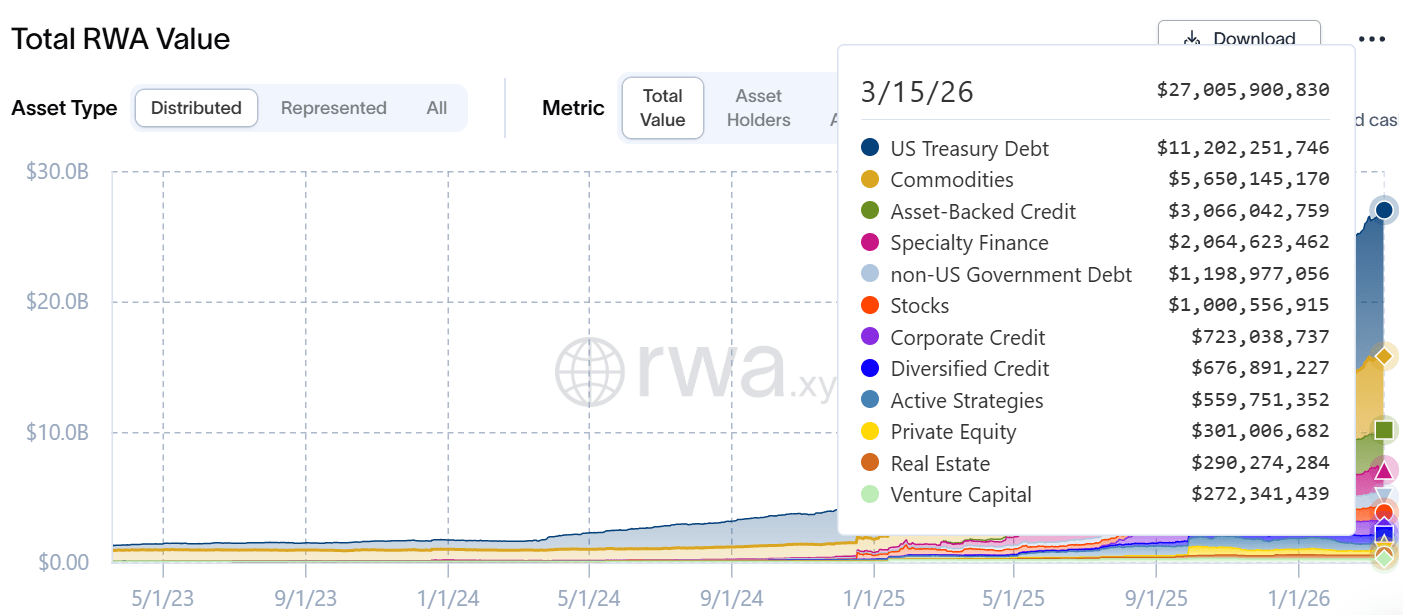
$27 billion may not seem like a lot, and this is just one sub-class of tokenized assets, but it’s still proof of growth.
An even more compelling piece of evidence comes from platform developments. BlackRock’s BUIDL fund (not a typo) is one such effort that’s within a stone’s throw of $3 billion in AUM. It acts as a bridge between traditional liquid instruments such as repos, treasuries and cash, and cryptocurrencies. Its multi-chain approach allows transactions to happen across blockchains (7 as of the last count), positioning it as a “tokenized money market fund”.
The rapid growth of this fund’s managed assets to $500 million within four months of launch in March 2024, and now to near $3 billion within two years is another sign that blockchains are on a proliferation path. This, of course, can change over time.
Our third piece of evidence is enterprise adoption within the traditional financial and banking system (TradFi, as opposed to DeFi). JPMorgan Chase & Co. (JPM) has positioned its Kinexys distributed ledger platform as a suite of enterprise solutions intended “to automate complex financial operations and unlock asset utility”, and transaction volumes have surpassed the $1.5 trillion mark.
Blockchain is growing in popularity and usage, but the question is whether these growth drivers can be accurately capture by BLCN. That still remains to be seen.
Risks
It might seem logical to link the price of cryptos like Bitcoin to the actual economic value of blockchain technologies, but that would be a big mistake.
Think of this as the foundational infrastructure underlying cryptocurrencies and all things blockchain, not the utility value it results in. It’s this foundational growth that BLCN is attempting to capture, not the more volatile utility value that the price of (BTC-USD) would seem to represent.
That’s a really crucial part of your investment decision. You can be invested in both, but it’s a good idea to recognize that difference. The value can be captured directly by holding digital assets like cryptocurrencies that have upside potential at any given time, but capturing growth in the underlying infrastructure and technologies is a little more tricky, as BLCN has shown.
This article answers three questions about BCLN:
- How does BCLN reflect the blockchain technology subsector?
- What impacts BCLN’s growth?
- What risks accompany investing in BCLN?
Editor’s note: This article is intended to provide a general overview of the ETF for educational purposes only and, unlike other articles on Seeking Alpha, does not offer an investment opinion about the ETF.