
MicroStockHub/iStock via Getty Images
Fast Facts
The State Street SPDR EURO STOXX 50 ETF (FEZ) was launched on 10/15/2002 and tracks the EURO STOXX 50® Index. FEZ has a portfolio of 50 stocks, a 30-day SEC yield of 2.08%, and an expense ratio of 0.29%. Distributions are paid quarterly. It is a large and liquid ETF, with $4.5 billion of AUM (assets under management) and an average daily dollar volume of $151 million. The fund’s issuer, State Street Corporation, is a financial services and bank holding company headquartered in Boston, with over $5 trillion in assets under management and over $50 trillion under custody.
Strategy
The underlying index focuses on Eurozone equities. It selects 50 of the largest companies representing approximately 60% of the free-float market capitalization of the EURO STOXX Total Market Index, which covers at least 95% of the free-float market capitalization of the represented countries. The index is weighted based on free-float market capitalization and undergoes an annual reconstitution in September. The fund’s turnover rate was 10% in the most recent fiscal year. All the stocks held in the portfolio trade in euros, and the fund is not hedged against currency risk.
This article will use as a benchmark the oldest European equity ETF: iShares Europe ETF (IEV). IEV tracks the broader index S&P Europe 350, which includes smaller companies and non-Eurozone European countries, in particular the U.K., Switzerland, Denmark, Sweden, and Norway.
Portfolio
The fund is almost exclusively invested in large- and mega-cap companies (about 97% of asset value), with a focus on France (33.3%) and Germany (29.5%).
FEZ geographical allocation (State Street)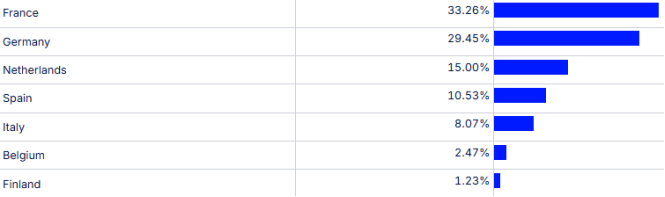
The portfolio has significant exposure in financials (25.1%), industrials (21.2%), and technology (15.2%). Compared to IEV, FEZ mostly overweights technology and consumer discretionary, while it downplays healthcare and consumer staples. These sector representations will shift over time based on market movements.
FEZ industry breakdown, % of assets (Chart: author; data: State Street, iShares)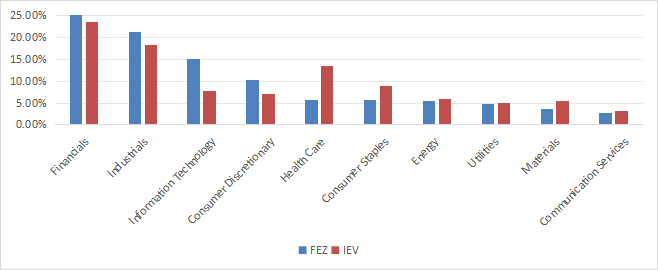
As for company-specific risk, the Dutch semiconductor company ASML Holding N.V. (ASML) weighs in at 10.2% of asset value at the time of writing. Other issuers are below 5%. The top 10 holdings, listed in the next table, have an aggregate weight of 41.2%. This fund tends to be top-heavy.
Fundamentals
FEZ has better fundamentals than IEV, as reported in the table below. Its valuation ratios are marginally lower, and its growth rates are slightly higher. Compared to a U.S. benchmark (SPY), the Eurozone equity market has strong value characteristics, with significantly lower valuation and growth metrics.
Data: Fidelity
The portfolio composition and metrics are given as an example from 3/27/2026. They may have changed by the time you read this.
Performance
FEZ has underperformed IEV by 31 bps annualized from 10/22/2002 to 3/27/2026, with higher volatility.
Data: Portfolio123
Nonetheless, FEZ is leading by 87 bps annualized over the past 10 years, and the two funds have the same Sharpe ratio (a measure of risk-adjusted return) in this time frame.
The annual sum of distributions has increased by 72% between 2015 and 2025, outpacing inflation (about 38% based on CPI). Most of the dividend growth happened after 2022, as plotted below.
Distribution history (Seeking Alpha)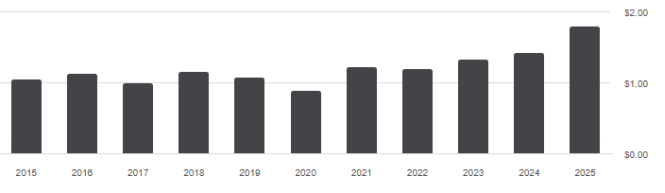
Competitor
The next table compares characteristics of FEZ and its closest competitor, iShares MSCI Eurozone ETF (EZU).
*Calculated with Portfolio123 from 11/9/2017 to match inception dates.
EZU has a broader portfolio, but FEZ is more compelling than its peer, with a lower expense ratio, better total return since November 2017, and similar volatility and drawdown. Additionally, it has slightly higher dollar trading volumes, even though its assets under management are inferior.
Franklin FTSE Eurozone ETF (FLEU) also tracks a Eurozone equity ETF, but its AUM and liquidity are low, and it changed strategies in 2023, making returns incomparable (it was previously currency-hedged and included non-Eurozone countries).
Takeaway: Who Should Consider FEZ?
FEZ is well-suited for an allocation in Eurozone equities, either long-term or tactical. Compared to the S&P 500, FEZ offers attractive valuation. U.S.-based investors willing to hedge their position in FEZ against currency risk may take a short position of the same notional dollar value in the EUR/USD pair in the forex market or derivatives. This aims to get in USD the return of the fund’s underlying index measured in euros. Investors who seek plain exposure to the Eurozone economy and those who are bearish or neutral on USD don’t need hedging.
- Pros: high liquidity, good value.
- Cons: concentration, excludes non-Euro European countries.
This article answers these three main questions about FEZ:
- How is FEZ’s portfolio structured?
- How does FEZ compare to benchmarks and peers?
- What type of strategy is FEZ best suited for?
Editor’s note: This article is intended to provide a general overview of the ETF for educational purposes only and, unlike other articles on Seeking Alpha, does not offer an investment opinion about the ETF.