
peepo/iStock via Getty Images
Historical Summary
It has been more than 32 years since I discovered the writings of Warren Buffett, Benjamin Graham, John Templeton, Philip Fisher and Peter Lynch. I then decided to begin managing a family portfolio based on an investment approach synthesized from these great money managers. By the end of 1998, after five years of satisfactory results, I decided to launch an investment management firm offering asset management services aligned with my own investment philosophy. Giverny Capital Inc. came into existence.
In 2002, Giverny hired its first employee: Jean-Philippe Bouchard (JP). A few years later, JP became a partner and participates actively in the investment selection process for the Giverny portfolio. In 2005, two new people joined the firm who eventually became partners: Nicolas L’Écuyer and Karine Primeau. François Campeau, who joined the Giverny team in 2018, also participates in the investment selection process. In 2009, we launched a US office in Princeton, New Jersey. We also partnered with a manager from New York, David Poppe, in early 2020. He manages Giverny Capital Asset Management, based in Manhattan. Both directors of our US offices, Patrick Léger and David Poppe, share in the culture and long-term time horizon inherent to Giverny.
We are Partners!
From the very first days of Giverny, the cornerstone of our portfolio management philosophy was to manage client portfolios in the same way that I was managing my own money. Thus, the family portfolio I’ve managed since 1993 (the “Rochon Global Portfolio”) serves as a model for our client accounts. It is crucial to me that clients of Giverny and its portfolio managers are in the same boat! That is why we call our clients “partners“.
The Purpose of our Annual Letter
The primary objective of this annual letter is to discuss the results of our portfolio’s companies over the course of the prior year. But even more importantly, our goal is to explain in detail the long-term investment philosophy behind the selection process for the companies in our portfolio. Our wish is for our partners to fully understand the nature of our investment process since long-term portfolio returns are the fruits of this philosophy. Over the short term, the stock market is irrational and unpredictable (though some may think otherwise). Over the long term, however, the market adequately reflects the intrinsic value of companies. If the stock selection process is sound and rational, investment returns will eventually follow. Through this letter, we provide you with the information required to understand this process. We try to be transparent and comprehensive in our discussion. The reason for this is very simple: we treat you the way we would want to be treated if our roles were reversed.
The Artwork on the cover of the 2025 Letter
We illustrate the cover page of our annual letters with a reproduction of a work from the Giverny Capital Collection each year. This year, we have selected a painting by Québec artist Guido Molinari entitled “Triangulaire jaune-orange”.
For the year ending December 31st, 2025, the return for the Rochon Global Portfolio was 2.7% versus 13.7% for our benchmark, which represents a relative underperformance of 11.0%. The returns of the Rochon Global Portfolio and our benchmark include a loss of approximately 4.3% due to fluctuations in the Canadian currency.
Since its inception on July 1st, 1993, the compounded annual return of the Rochon Global Portfolio has been 14.7% versus 9.9% for our weighted benchmark, representing an annualized outperformance of 4.8% over this period of 32 years. Our long-term and ambitious objective is to maintain an annual return 5% higher than our benchmark.
The Rochon Global Portfolio: Returns since July 1st, 1993
Here are the same results of the Rochon Global portfolio in graphical form:
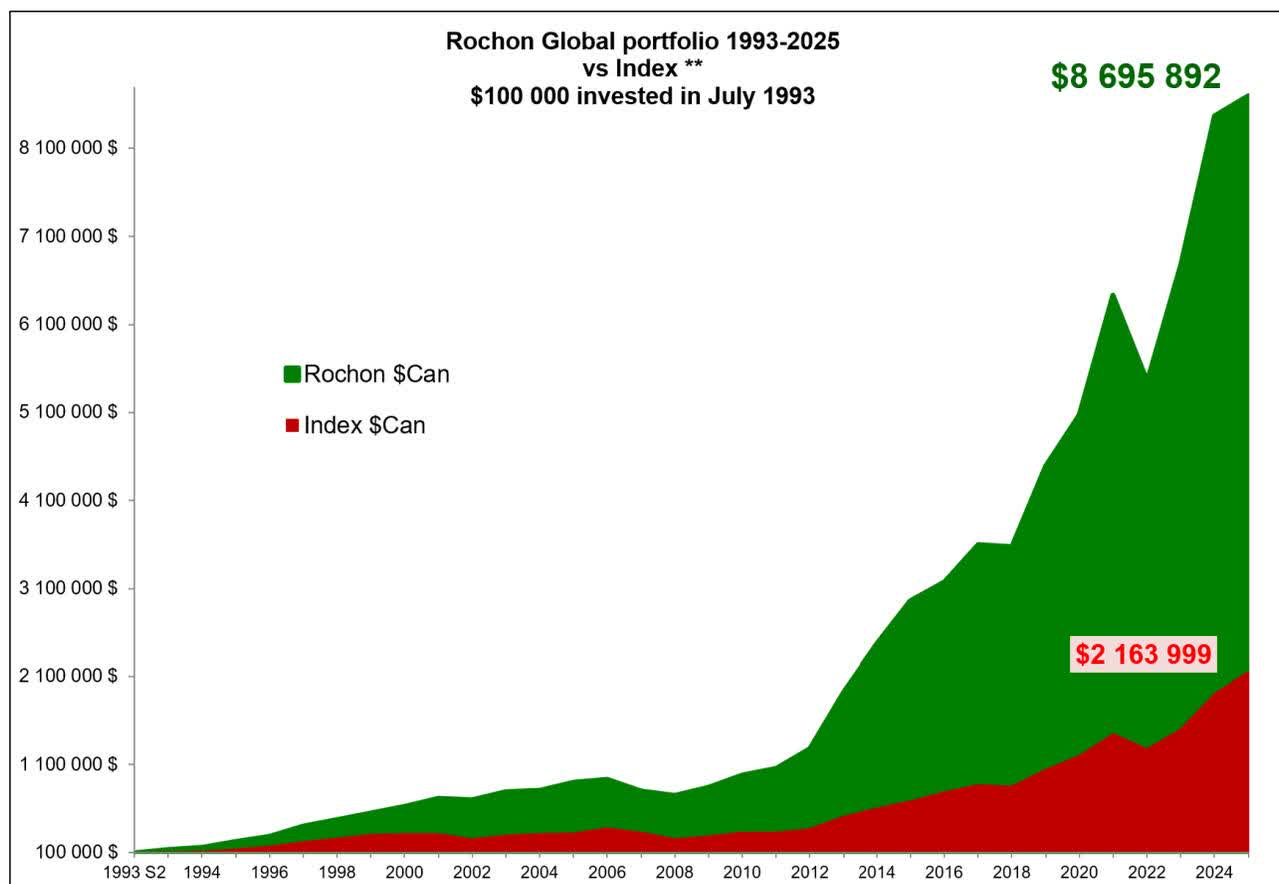 green) and Index $Can (red). The Y-axis represents value in Canadian dollars from 100 000 $ to 8 100 000 $. The X-axis shows time from 1993 S2 to 2024. The final values are $8 695 892 for Rochon and $2 163 999 for the Index." width="640" height="442" loading="lazy" srcset="https://i0.wp.com/static.seekingalpha.com/uploads/2026/3/31/55028208-17749388263189504_origin.jpg?io=w640+640w%2Chttps%3A%2F%2Fstatic.seekingalpha.com%2Fuploads%2F2026%2F3%2F31%2F55028208-17749388263189504_origin.jpg%3Fio%3Dw480+480w%2Chttps%3A%2F%2Fstatic.seekingalpha.com%2Fuploads%2F2026%2F3%2F31%2F55028208-17749388263189504_origin.jpg%3Fio%3Dw320+320w%2Chttps%3A%2F%2Fstatic.seekingalpha.com%2Fuploads%2F2026%2F3%2F31%2F55028208-17749388263189504_origin.jpg%3Fio%3Dw240+240w&ssl=1" sizes="(max-width: 767px) calc(100vw - 36px), (max-width: 1023px) calc(100vw - 180px), 552px"/>
Looking at this graph, one might think it was a period of strong growth that unfolded almost in a straight line without any major crises. This was not the case. If we used a wider X-axis, for example, on a weekly basis, we would see numerous and sometimes enormous fluctuations in the financial markets since 1993. There were plenty of crises: the stock market fell by 50% twice and by more than 20% nine times over these 33 years.
More than anything, the graph above illustrates an important lesson in stock market investing: the benefits of having a long-term perspective. Persevering, tooth and nail, in rigorously adhering to our investment principles and adding a good dose of patience, against all odds, has allowed us to achieve satisfactory results. Fads come and go, but sound principles endure.
Impact of the Canadian Dollar Against the US Dollar on Our Returns
It is also instructive to observe in the table on the previous page that the currency fluctuation effect has had virtually no impact on our returns in the end: since 1993, the Canadian dollar has depreciated by a total of 7.0% against the US dollar. This corresponds to a positive annualized effect of approximately 0.2% on our returns.
The Rochon US Portfolio
We have been publishing the returns of the Rochon US Portfolio, which is entirely denominated in US dollars, since 2003. The Rochon US Portfolio corresponds approximately to the US portion of the Rochon Global Portfolio. In 2025, it realized a return of 7.6% compared to 17.9% for the S&P 500. The Rochon US Portfolio therefore underperformed its benchmark by 10.3%. Since its inception in 1993, the Rochon US Portfolio has returned 6839%, or 13.9% on an annualized basis. During this same period, the S&P 500 returned 2713%, or 10.8% on an annualized basis. Our added value has therefore been 3.1% annually.
Refer to Appendix B for disclosure statements on the Rochon portfolios.
Rochon Canada Portfolio
We introduced a portfolio that is 100% focused on Canadian equities in 2007. This corresponds approximately to the Canadian portion of the Rochon Global Portfolio.
In 2025, the Rochon Canada Portfolio returned 4.9% versus 31.7% for the S&P/TSX, therefore underperforming its index by 26.8%.
Over 19 years, the Rochon Canada Portfolio has returned 1678%, or 16.4% on an annualized basis. During this same period, our benchmark had a gain of 332%, or 8.0% on an annualized basis. Our annual added value was therefore 8.4%.
Refer to Appendix B for disclosure statements on the Rochon portfolios.
Constellation Software’s (CNSWF) stock price fell by 26% in 2025 (we’ll come back to that later). Our other major Canadian holding, Dollarama (DLMAF), rose by 46%.
Since 2007, the performance of our Canadian stocks has significantly outperformed the S&P/TSX. It’s important to keep in mind, of course, that a highly concentrated portfolio, like this one, can have drastic return differences with the indices from one year to the other (and this was clearly the case this year).
The S&P/TSX’s singular 31.7% return in 2025 is mainly due to three reasons:
1) Canadian banks—which represent by far the largest weighting in the Canadian index—performed exceptionally well, benefiting from an abnormal increase in their average price-to-earnings ratio from 11 to 15 times (that’s a 36% increase). I use the word “abnormal” deliberately: historically, the average P/E ratio of Canadian banks has fluctuated between approximately 9x and 14x.
2) The stock of Shopify (SHOP) performed exceptionally well and became the second-largest component of the index after the Royal Bank. It’s worth noting that the stock’s price-to-earnings ratio exceeds 100x!
3) Finally, gold stocks also performed abnormally well: the five largest components of the TSX Gold sub-index climbed 140% this year.
And yet, it was a modest economic year for Canada: in 2025, GDP growth was 1.7% compared to 2.2% in the United States. And productivity grew by approximately 1.1% versus 2.2% in the US.
2025
We don’t need to look very far to identify what was the defining story of 2025: Artificial Intelligence (which we’ll abbreviate as AI for the rest of this letter). A strategist at JPMorgan estimated that since OpenAI launched ChatGPT in November 2022, a basket of 41 AI-related stocks has generated 75% of the S&P 500’s return, 80% of the index’s profit growth, and 90% of its capital expenditure growth. We only own two companies in this group of 41: Alphabet (since 2011) and Meta Platforms (since 2018).
At Giverny, we use many AI tools on a daily basis to accomplish various research and analysis tasks. Fully aware of its impressive benefits, AI is, in our eyes, a revolution that we do not underestimate for a single second. This does not mean, however, that the economic predictions and financial valuations that stem from it will all prove to be justified.
By 2025, it is estimated that hyperscalers will have spent over $400 billion ($B) on AI data centers, and this figure is projected to reach approximately $700B by 2026. The entire AI ecosystem has become very complex in just a few years, and an “investment circle” has emerged that roughly resembles this (I have included two different sketch versions):
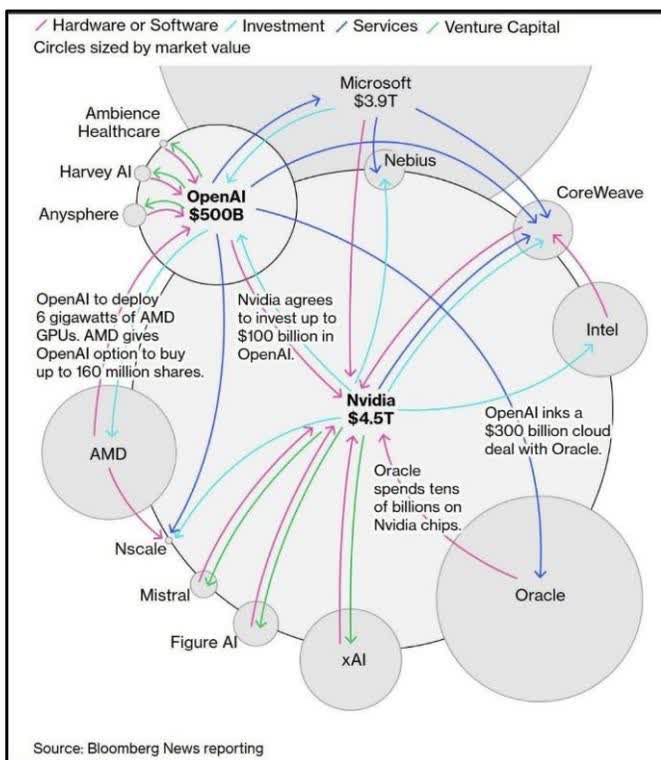

To get a clearer picture of the situation, let’s take an example within this circle. First, Nvidia (NVDA) invests $100 billion in OpenAI. OpenAI — which only generates around $20 billion in annual revenue and is operating at a loss — signs a $300 billion contract with Oracle (ORCL) for cloud computing systems. With this contract in hand, Oracle places a $40 billion order to purchase GPUs (Graphics Processing Units) from Nvidia. Nothing is necessarily wrong from an economic standpoint, and it’s all certainly legal (as long as everything is disclosed).
The question investors should be asking, however, is this: let’s say Oracle buys $40 billion worth of GPUs from Nvidia over three years (money that Nvidia itself indirectly funded), and this translates into $7 billion in after-tax profit per year spread over three years. How do you value this yearly profit? If Nvidia’s stock is trading at 25 times earnings, investors are paying $175 billion for those $7 billion in profits. There would be a mathematical logic to capitalize at 25 times these profits if they were recurring for a few decades. But that’s not always the case: in this example, it’s three years’ worth of these profits that would need to be capitalized. It therefore seems to me—in the way I’ve presented it—that we must exercise caution when valuing these kinds of situations.
Most of these companies are likely destined for a bright future. The problem for an investor is how to measure, even approximately, their true long-term profit potential and, consequently, their fair intrinsic value. Because—and this should never be forgotten—in the long run, the stock market always ends up reflecting the underlying intrinsic value of companies.
Alongside the popularity of AI-related stocks, Wall Street is severely punishing stocks of companies in various sectors such as software, companies offering various information services, and even engineering firms, out of fear that their business model will be heavily disrupted by AI. Portfolio holdings such as Constellation Software, Booking.com, and even Charles Schwab have been penalized in the stock market not because of poor results, but due to fears that AI could affect them in the future. Wall Street’s typical approach is to sell first and examine the facts later. This thus affects some of our companies in a disproportionate manner relative to current economic reality. Of course, we must remain completely clear-headed and vigilant with respect to AI; but we must also keep a cool head and not allow hypothetical fears to cast a shadow over everything. Knowing how to exercise nuance is a vital quality in investing.
The dominance of the 10 largest American companies and their resulting valuation
Source : FactSet, Standard & Poor’s, J.P. Morgan Asset Management
The mega-cap stocks of the S&P 500 continued to dominate index performance in 2025. The 10 largest weightings in the S&P 500 now represent 41% of the index’s value. The remaining 490 stocks therefore represent only 59%. Looking at the chart above, the S&P 10 (the top 10 stocks in the index) is currently trading at approximately 28 times projected earnings for the next 12 months (in green). This brings the S&P 500 index to over 22 times projected earnings for the next year (in gray). This means that the S&P 490 is trading at approximately 19 times, a ratio more in line with the historical average (in blue). This disparity has been present for several years, as you can see in the chart. We are far from the peak level of 2000, but it should be noted that during the period from 2002 to 2017, a more in-line relative valuation had been restored. In the long term – am I repeating myself? – the stock market will likely eventually normalize valuations and accurately reflect the intrinsic value of companies, regardless of their size.
Portfolio Review for 2025: Explanations, Not Excuses
It has been a challenging year for our portfolio. From the very first day I began managing the capital of our partners (the name we give to Giverny’s clients), it was imperative for me to adhere to strict fundamental stewardship principles. First, partners and I are in the same boat: I buy for you what I buy for myself. This doesn’t guarantee results, but it does ensure our interests are aligned. Second, I treat partners the way I would want to be treated if the roles were reversed. The purpose of this annual letter is therefore to provide you with all the information I would want to know if I were in your position. Not only is the letter comprehensive, but it is also transparent. And when results fall short of my expectations, I don’t try to hide behind excuses: I offer you the most honest and clear explanations I can.
We first had two stocks that fell sharply in 2025: Carmax (KMX) and Fiserv (FISV). Both represented approximately 4% of the portfolio at the beginning of the year, and both declined by more than 50% during the year.
Carmax was first acquired in 2007. Over the years, we have sometimes reduced and sometimes increased our stake (decisions based on the market valuations at the time). From 2007 to 2021, Carmax’s earnings per share (EPS) grew from $0.92 to $6.97. This was an exceptional annualized growth of 16%.
However, a new competitor entered the market in 2017: Carvana (CVNA). The company offered used car purchases exclusively online. The company was highly unprofitable, but its business model was popular with a certain segment of consumers. Carvana nearly went under in 2022 (its stock price fell by 98%) but found a way to survive. Since 2018, Carmax has adapted by investing large sums in an omnichannel approach that offered a combination of online and in-person purchasing. At the same time, the company also faced increased competition in its industry from new car dealerships like Autonation. The company accepts lower gross profit margins than Carmax, allowing it to gain market share and leverage its repair services as an indirect source of revenue (something Carmax doesn’t offer).
We met with Carmax management several times, most recently last spring. Everything indicated that things were improving. However, the summer and fall were challenging, and sales and profits declined. The board of directors decided to change the CEO. We had to recognize that we had been patient enough and decided to sell. Ultimately, we achieved a positive return on this investment over the 18 years we were shareholders; however, it was a very low number and well below our targets.
Fiserv was acquired in March 2023. The company had a phenomenal track record with 37 consecutive years of EPS growth since its IPO in 1987. Fiserv acts as the invisible infrastructure of the banking and payments system. Simply put, the company provides the “rails” on which money flows between consumers, merchants, and banks. In 2019, it made a major acquisition: First Data. First Data’s former CEO, Frank Bisignano, then took the reins at Fiserv. With First Data, Fiserv acquired its now flagship product: Clover, an all-in-one point-of-sale (POS) system for small businesses that manages payments, inventory, and employees.
But then came a dramatic turn of events: in May 2025, Mr. Bisignano left his position at Fiserv to lead the U.S. Federal agency Social Security Administration (SSA), and, a few months later, the Internal Revenue Service (IRS). We found this decision surprising but decided to remain shareholders. This was a mistake. The situation deteriorated under the new management: the company had been overly optimistic about its growth prospects in 2025. We did not appreciate the way the new management addressed the difficulties. Furthermore, given Fiserv’s debt level, we were concerned that a potential decline in profits would affect our comfort level regarding the company’s balance sheet. Although the stock appeared significantly undervalued to us, the risk had, in our opinion, increased to a level where we were no longer comfortable remaining shareholders. We acquired our first shares at $118 in 2023 and sold them at $74 last October.
The other factor contributing to our underperformance was the sharp decline in Constellation Software’s stock price, our largest holding at the beginning of the year. Wall Street has become very negative on almost all software companies, viewing AI as a destroyer of the industry. The rhetoric suggests that in the near future, individuals and companies will be able to have algorithms and computer program code written automatically. However, the consumer market is not the same as the enterprise market. For businesses, the software they use has often been installed over decades, is designed for specific needs, and plays a critical role in their daily operations. Furthermore, the value of their accumulated customer and supplier data is significant, sometimes exceeding the value of the software itself.
Constellation’s stock price has fallen by 26% in 2025 (and by another 12% to date in 2026). Such a decline is completely unrelated to the company’s current situation. Indeed, revenue climbed 15% in 2025 and adjusted EPS by 21%. Since our initial purchase in 2014, EPS has grown at an annualized growth rate of 20%. Despite the recent stock price drop, the share price has still risen by more than 1000% since our first purchase 12 years ago.
In our opinion, Constellation Software is not as threatened by AI as some believe. And if it is in certain aspects of its business model, it can adapt (it already uses AI in several areas of its operations). It’s important to understand that Constellation owns more than 1000 different companies acquired over the past 30 years, each occupying a niche in a specific market. Constellation has always prioritized software that drives businesses or key aspects of them, where seamless data continuity is essential, and where processes and user interfaces are paramount in their clients’ daily operations. The software is often fully integrated into the client’s operations while rarely representing a significant cost – relatively speaking. For example, it seems unrealistic to believe that an operator of a dozen mini-golf courses is going to start coding their own AI-powered reservation software to save something like $5,000 in annual fees!
The other news that affected – to a lesser extent – Constellation’s stock is the departure of Mark Leonard. We have immense admiration for Mr. Leonard, and I often mentioned that he was my favorite CEO of the companies we own. Mark experienced serious health issues this fall, to the point where his life was in danger. He therefore had to resign and undergo emergency surgery. The good news is that the surgery went well, and Mark is now out of danger. He will therefore remain on the company’s board of directors.
His replacement as CEO is Mark Miller, Mark Leonard’s right-hand man since Constellation’s inception in 1995. He was by his side throughout Constellation’s development. In our opinion, there could be no better successor. Mark Miller has already addressed the entire company structure to better understand and adopt AI. To date, management has not seen any negative impact of AI on their operations, but they remain vigilant. Mark wants Constellation’s various entities to be able to reinvent themselves if necessary to avoid becoming victims of AI. He has tasked all of Constellation’s diverse units trying to solve new problems for their clients using AI and generating new revenue streams through it. AI could even be an indirect opportunity for Constellation: the company grows primarily through acquisitions, and clearly, the cost of potential target companies has just dropped dramatically. A lower price paid means a better return on invested capital.
We had already reduced our stake in Constellation several times (when it exceeded 10% of the portfolio). We had also sold our shares in Topicus and Lumine – shares distributed at zero cost by Constellation – because they seemed to be trading at high levels. Both stocks have also fallen by about 50% since then. We therefore managed the risk appropriately. Nevertheless, the decline in Constellation’s share price hurt our portfolio in 2025 and again in early 2026. We estimate the negative impact of the share price decline for 2025 at 2%. We have confidence in both Constellation’s resilient business model and the qualities of its new CEO. We therefore intend to keep our shares while, of course, closely monitoring the situation.
Finally, the last factor that affected our portfolio was the approximately 5% rise in the Canadian dollar. Since we have roughly 85% of the portfolio invested outside Canada and 15% invested in Canada (the Canadian market’s weight in the global economy is 2% to 3%), the rise in the Canadian currency impacted our return when expressed in Canadian dollars. As explained above, since 1993, fluctuations in the Canadian dollar have had a total effect of increasing our overall return by 7%, representing a 0.2% annual positive impact. Therefore, currency fluctuations over one or two years should be taken with a grain of salt.
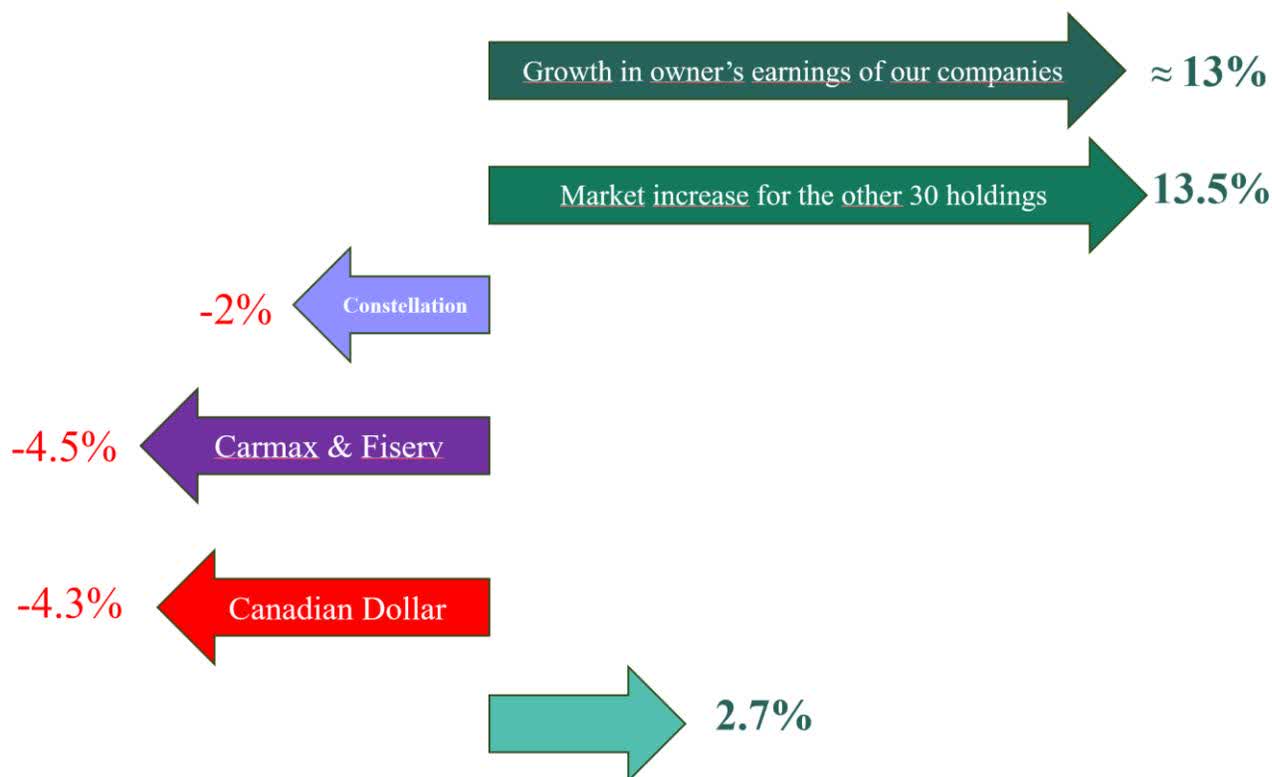
Now for the good news: we estimate that our companies as a whole have increased their intrinsic value by approximately 13% this year. This includes the negative impact of Carmax and Fiserv on this growth (even though both stocks were sold this fall). Excluding the three stocks mentioned above, the stock market performance of all other stocks in the portfolio was entirely in line with the growth of their overall intrinsic value, representing an approximate return of 13.5% (before currency fluctuations). The following chart illustrates the factors that led to the disappointing return of 2.7% (expressed in Canadian dollars) in 2025:
History doesn’t repeat itself, but it rhymes: the lessons of railway securities.
Massive investments in AI infrastructure are so significant that it seems relevant to try to gain a historical perspective to weigh their potential consequences.
We could first draw a parallel between investments in AI data centers and the proliferation of fiber optics at the beginning of the internet in the 1990s. Several telecom companies from a quarter of a century ago that spent tens of billions of dollars on fiber optic networks went bankrupt, such as 360 Networks, Worldcom, and William Communications. One of the industry’s top companies, Level 3 Communications, had a market capitalization of $44 billion in 2000; it was acquired by CenturyLink in 2017 for $34 billion, a 23% drop in value over 17 years.
Furthermore, several traditional telecom companies like AT&T and Verizon have achieved very low returns on their massive investments. The mistake investors made in these companies was simplistically extrapolating the strong growth of internet traffic while ignoring the fact that fiber optic capacity increases exponentially with improvements in optical technologies.
If you’ll allow me to delve even further back into the history of our civilization, I find another suitable analogy: that of the railroad industry in the 19th century. It’s a fascinating story, the subject of several history books, and certainly beyond the scope of this letter. But I will nevertheless attempt to summarize the lessons of this era of capitalism in a few paragraphs1.
The American Civil War clearly demonstrated the usefulness of the railroad. During the six years that followed, from 1865 to 1871, the number of new railroads laid annually increased from 1,000 miles to 7,000 miles. By 1873, 75% of railroad securities were held by British and Dutch investors seeking growth unattainable in Europe. In September 1873, the prestigious Jay Cooke & Company went bankrupt while attempting to finance the construction of a second transcontinental line in the United States, triggering a domino effect. From 1873 to 1879, nearly half of all railroad bonds defaulted (the equivalent of $134 billion in today’s dollars).
The 1880s saw another phase of massive investment. The problem that arose was that there were too many railroads for the demand for transportation, and the prices per transport subsequently fell sharply. In 1893, another crisis struck, and the collapse was even more dramatic: the length of track laid plummeted from 12,000 miles in 1887 to less than 2,000 miles in 1893. That year, 74 railway companies went bankrupt. By 1897, 192 American railway companies were bankrupt, representing 25% of the country’s total track.
The history of rail in Canada was even more turbulent. Approximately 300 railway companies were established in Canada. Most never became profitable: the interest payments on their debts were too high relative to the revenues generated. The Canadian National Railway (CN)(CNI) was created in 1918 by the Canadian government to nationalize all the railway companies in financial difficulties. Apart from the Canadian Pacific Railway (CP), almost all other companies had to be nationalized to such an extent that two-thirds of Canada’s railway lines were taken over by the government to ensure their survival.
In a near duopoly situation with CP, CN should have been a profitable company overall, especially during the years of strong economic growth following the Second World War. This was not the case.
Here is a graph summarizing CN’s revenue and profitability figures for the period from 1923 to 1965 (you can find all sorts of information on the Government of Canada’s websites!):
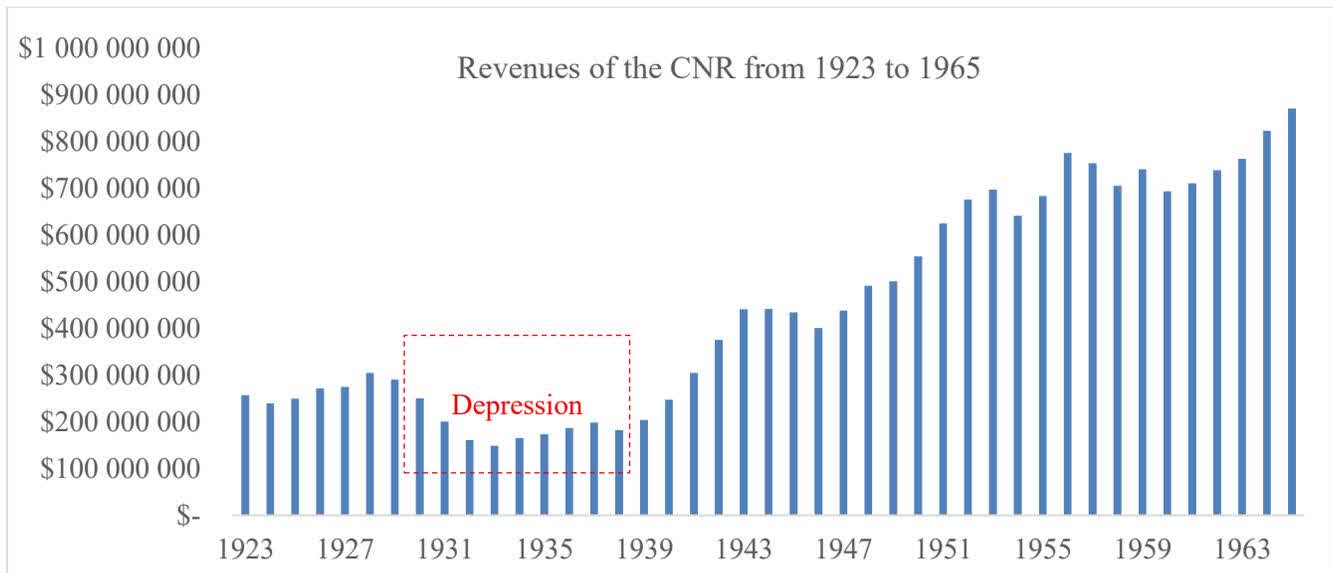
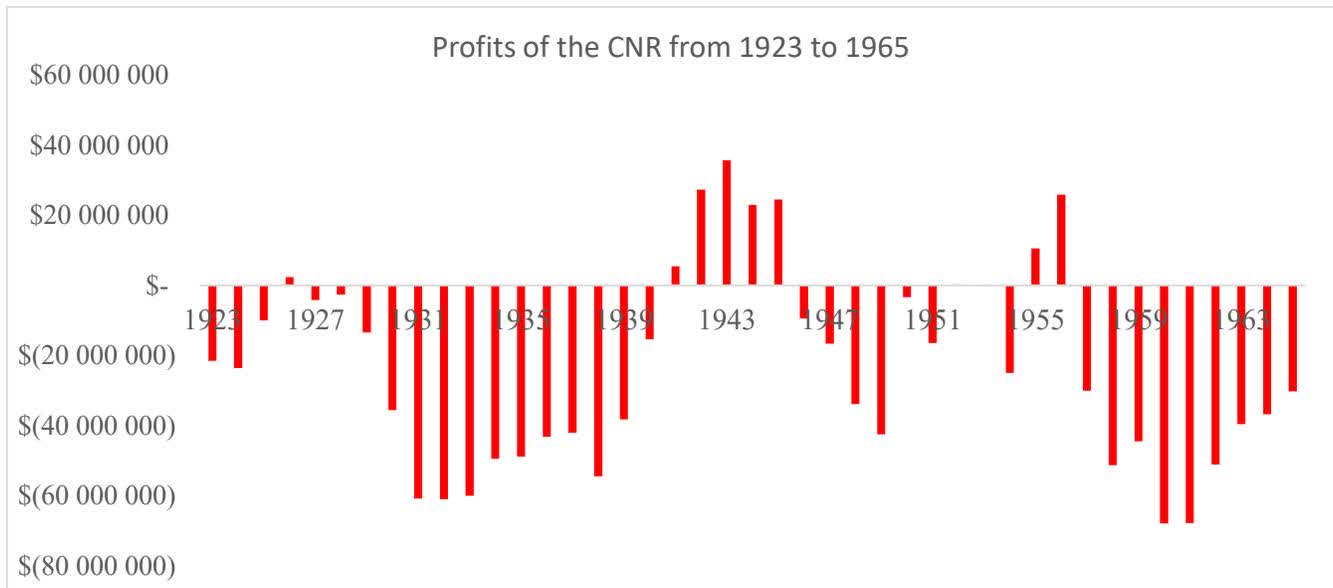
During the first four decades of CN’s existence, the government had to invest nearly $2.6 billion in railway assets, issuing $1.6 billion in debt (the balance being financed by federal contributions). With the resulting interest charges, CN accumulated total losses of $995 million from 1922 to 1965 and was profitable only on a few occasions. In 1992, CN began a major restructuring and reported a massive loss of $840 million. The government then privatized the company in 1995. Eventually, under the leadership of Quebecer Paul Tellier, CN became a highly profitable company… eight decades after its creation.
We should add another point to our analogy. In a way, trains are still running on tracks laid 150 years ago. The lifespan of rails is approximately 30 to 50 years. Similarly, internet traffic today uses the same fiber optic cable installed 30 years ago.
For the GPUs used by AI servers (approximately one-third of a data center’s investment), the competitive lifespan is estimated at 3 to 5 years. When a company like Google spends large amounts of money on AI servers with the cash generated by its massive advertising business, that’s one thing. At worst, it will write off some of its investments; its survival won’t be at stake. When a company with almost no revenue takes on tens of billions of dollars in debt to build AI data centers whose GPUs will be obsolete in five years, that’s something else entirely.
Obviously, these massive investments in new technologies—like railroads, computers, fiber optics, AI infrastructure, and so on—are transformative for our civilization. They bring great benefits to the population and propel us toward a better life through giant leaps for mankind. It’s a good thing for our society that some investors are willing to take risks by allocating significant amounts of capital to new industries. The problem for an investor whose mission is to achieve good returns while managing risk prudently is that history has repeatedly shown that this type of investment is rarely, on the whole, profitable for early investors.
It is often the companies that arrive later in the cycle that reap the rewards once a certain stability has been established between supply and demand and the number of players vying for market share has been reduced. When you think about it, Google wasn’t the first company to offer internet search engines. In fact, when it was founded, the company had to compete with 20 search engines already battling for market share on the web (Yahoo!, Altavista, Lycos, Excite, Infoseek, Ask Jeeves, etc.). But it was Google, arrived four years after the others, that came to completely dominate this industry.
Postscript
You know me: I never miss an opportunity to tell a story glorifying capitalism. While the proliferation of railroads in the United States was a major source of financial losses in the 19th century, it also benefited some more enlightened businesspeople.
I would ask this question: what did the arrival of the railroad fundamentally change in the lives of 80% of Americans who were farmers at the time, and thus created a whole new need?
Answer: to deliver their crops, farmers now needed to know the time to arrive at the station on time (instead of relying on the sun’s position to manage their day). Richard W. Sears, the co-founder of Sears, Roebuck and Company, saw this as an opportunity to travel across the United States selling watches to farmers. And over the years, he left them a catalog with many other products they could buy (and have them delivered by train!).
At Giverny, we always keep our eyes wide open to be able to find companies that will benefit indirectly and more discreetly from a change in the economic paradigm.
Owner’s Earnings
At Giverny Capital, we do not evaluate the quality of an investment by the short-term fluctuations in its stock price. Our wiring is such that we consider ourselves owners of the companies in which we invest. Consequently, we study the growth in earnings of our companies and their long-term outlook.
Since 1996, we have presented a chart depicting the growth in the intrinsic value of our companies using a measurement developed by Warren Buffett: “owner’s earnings”. We arrive at our estimate of the increase in intrinsic value of our companies by adding the growth in earnings per share and the average dividend yield of the portfolio.
We believe that analysis is not exactly precise but approximately correct. In the non-scientific world of the stock market, we believe in the old saying: “It is better to be roughly right than precisely wrong.”
This year, the intrinsic value of all our companies has increased by approximately 13% (including dividends). Despite some portfolio adjustments, we believe this estimate of our companies’ EPS growth in 2025 accurately reflects their economic reality. Meanwhile, our equity holdings have returned approximately 7% (estimated without currency effects). As previously explained, our equity holdings have therefore underperformed our underlying companies.
The companies comprising the S&P 500 saw their profits increase this year by approximately 11.7% (for a total of 13%, including a dividend of approximately 1.3%). The index achieved a total return of 18% (including dividends).
Three Decades of Equity Returns
Since 1996 – exactly thirty years – our companies have seen their intrinsic value increase by approximately 3,690%, and their stock market returns have achieved a total return of approximately 3,585%. On an annualized basis, our companies have achieved an intrinsic return of 12.9%, compared to 12.8% for their stock market performance (dividends included in both cases, but adjusted for currency effects). Over those three decades, the similarity between these two figures is not a coincidence and is significant. This is inexorably consistent with the fundamental principle that, in the long run, stock market returns ultimately reflect the increase in the intrinsic value of the underlying companies (provided, of course, that a reasonable price was initially paid for said stocks).
It is instructive to divide these three decades into three distinct periods:
The only period in which our stocks have underperformed the S&P 500 is the last decade. In fact, the S&P 500 has outperformed the underlying performance of its constituent companies by 4.4% annually. This is due to an unusually high P/E ratio for the S&P 500 at the end of 2025: the current P/E ratio of the S&P 500 is 25 times earnings, while the median since 1996 is around 18 times. If the S&P 500 were trading at 18x, it would be 28% lower, and the gap between intrinsic and market performance since 2015 would be significantly reduced and more consistent with historical norms.
We are confident that if our companies continue to grow their intrinsic value at higher-than-average rates, the stock market performance of their shares will follow—in absolute terms and also relative to indices.
Five-year Post-mortem: 2020
We made a few new purchases in 2020, but the main one was acquiring shares of Five Below during the rapid market decline at the start of the pandemic.
We had been following this chain of stores with items under $5 (as its name suggests) for a few years. The company had maintained a growth rate of 20-25% per year, and its stock traded at high P/E ratios. At the beginning of the pandemic, Five Below had to close all its stores, and its stock quickly fell by 50%. We took advantage of this by buying shares at around $71.
Five Below’s stock rebounded quickly in 2021 and continued to perform well in 2022 and 2023. However, the company went through a more difficult period in 2024 (see last year’s annual letter). The company eventually decided to make a change in management, but it took a few quarters to produce results. In fact, by early April 2025—at the height of the US president’s tariff threats—the stock had fallen to $55. Our patience was sorely tested. I explained in our quarterly letters this year that I believed Five Below’s business model remained intact and greatly appreciated the company’s outstanding balance sheet (a real asset when times get tough!). New President Winnie Park got things back on track, and sales and profits rebounded by the end of the fiscal year. The stock is trading at $222 as I write this. We have therefore achieved a total return on our initial 2020 purchase of approximately 213%, or an
annualized return of nearly 21% over roughly six years. Our patience has thus been rewarded, even though after five years we were in loss territory.
The flavor of the day
Over the last few years, we have often discussed Bitcoin in this column. We can add gold as another flavor of the day in 2025. These two items have something in common: they are both assets impossible to value because they have no intrinsic worth. Moreover, they both rely on a chimerical skepticism regarding governmental economic institutions, primarily the essential role of a stable currency and of a solid central bank. The majority of gold and/or Bitcoin buyers do not purchase these assets for rational reasons but simply to sell them at a higher price to someone else. There is a name for this strategy: “The Greater Fool Theory.” In short, it is the hope behind buying an asset at a price without any rational basis for valuation, with the aim of selling it in the not-too-distant future (the sooner, the better) to an even more irrational person. History has taught us that this strategy always creates more losers than winners.
Of course, our intention is not to denigrate the millions of investors who engage in buying gold and/or cryptocurrencies (people are free to do what they want with their money!). We are simply explaining the logical reasons why we do not participate in that arena.
Our Companies
Note: This section of the annual letter is exhaustive. We want to provide you with an accurate update of the companies in our portfolio companies. In fact, we are trying to present you with the information we would like to know if our roles were reversed. Prices are as of December 31, 2025.
The Podium of Errors
Following in the Giverny tradition, here are our three annual medals for the “best” errors of 2025 (or from past years). It is with a constructive attitude, to always improve as investors, that we provide this detailed analysis. As is often the case with stocks, errors from omission (non-purchases) are often more costly than errors from commission (purchases)… even if we don’t see those on our statements.
Bronze Medal: Fiserv
I explained in detail what happened to Fiserv this year earlier in this letter. I believe I made two mistakes with this investment. The first is that I should have sold immediately when the CEO left the company to enter politics. We would have sold at roughly our cost price and thus limited the consequences of the more fundamental error that follows.
I am very familiar with the credit card transaction ecosystem, which includes issuers (banks), transaction processors (Fiserv), and payment networks (Visa, Mastercard). We have held Visa shares since 2010, and I know full well that it has the strongest business model in the ecosystem and, above all, with the widest economic moat. We invested in Fiserv, in addition to Visa, primarily because the stock was cheaper (approximately 15x earnings versus 25x for Visa). This was a mistake because I should have simply allocated that capital to Visa. We would have achieved a better return and would avoided many unnecessary headaches.
Silver Medal: Netflix
I’ve been a Netflix (NFLX) subscriber for years. And I admire the quality of their streaming platform and the vision their leaders have maintained for a decade. Unfortunately, for many years, the stock’s valuation was very high.
In 2022, the stock fell from a high of $69 (adjusted for stock splits) in 2021 to a low of $18, a drop of 74%. The P/E ratio thus fell to around 18x. I then studied the company in more detail. It’s true that EPS declined in 2022 by about 11%, and the number of subscribers seemed to be stagnating. There were therefore legitimate concerns. However, I believed the company had several avenues to increase its revenue and, above all, its profit margins: first, by increasing its subscription costs and also by optimizing its significant investments in new series and films.
The company quickly improved things: it adopted a strategy of adding advertisement options and better protecting its access (from users sharing the same access). It also significantly improved its operating margins by better managing its expenses and investments. Earnings per share increased by 150% in three years, and the stock price climbed back up to $77 (at the time of this writing), representing a 328% increase in just over three years. Unfortunately, I didn’t convert my enthusiasm into an investment.
Gold Medal: Canadian National Railway
In my brief (!) historical text about railways in this letter, you may have noticed that CN was privatized by the Canadian government in 1995. Its shares were then listed on the Toronto stock exchange. We could therefore have invested in it at that time. In Peter Lynch’s book “Beating the Street,” published in 1992, there was this rule: “Whatever the Queen is selling, buy it!” But unfortunately, I ignored Peter’s rule and passed on it.
The following figures will send chills down your spine: the share price has risen from $1.75 in December 1995 (adjusted for stock splits) to $136 in December 2025. With the dividends received over the years, we’re talking about an approximate annual return of 17% over 30 years. Would you believe me if I told you that this is a better return than Microsoft’s for the same period?
Conclusion: It was twenty years ago…
It would be instructive to revisit the flavor of the day from two decades ago: oil. Between 2005 and 2007, oil was very popular (and the oil producers’ stocks, by extension). The scenario favored by the enthusiasts of the time was that, with growing demand from China, we would run out of oil in a few decades, and therefore prices would continue to climb indefinitely.
The years 2006 and 2007 were very difficult for the Giverny partners, as we underperformed the indices—then inflated by oil stocks—and, in addition, we had to contend with a very sharp rise in the
Canadian dollar… which proved painful but temporary. Clearly, we experienced all sorts of financial markets way before today and have had our share of periods of unpopularity for our investment style.
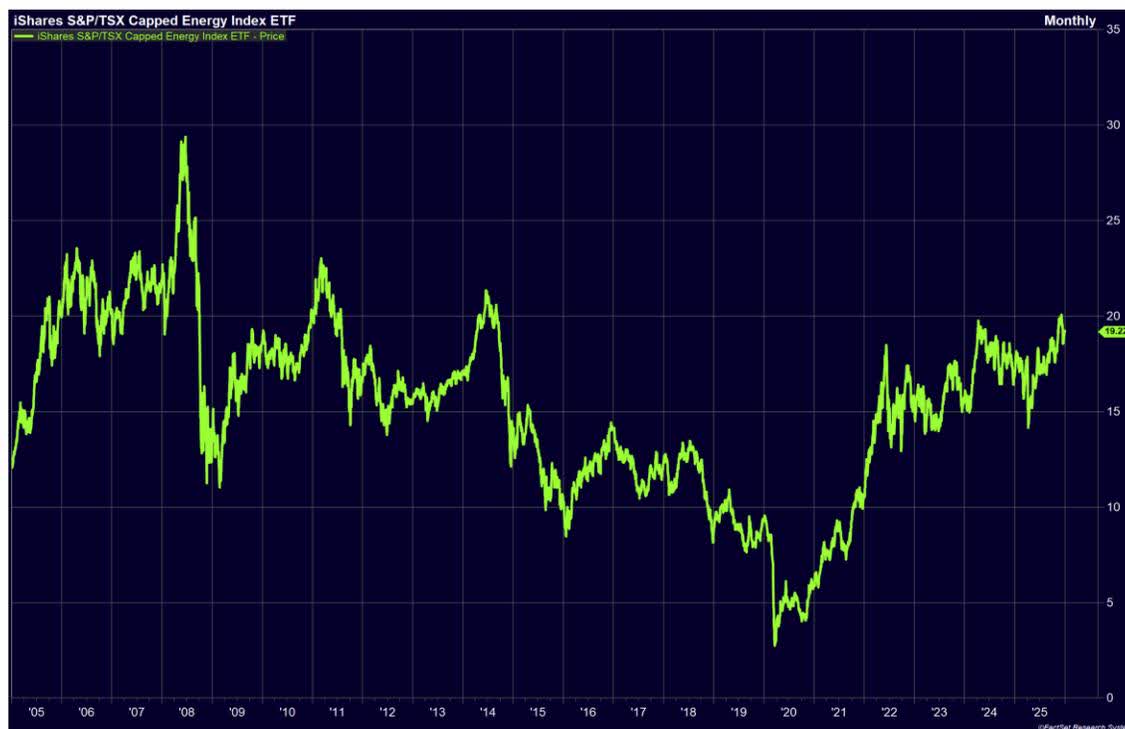
The most popular index fund in Canada at that time was the iShares S&P/TSX Capped Energy Index ETF (XEG). I remember speaking to several partners in 2007 who wanted to put all or nearly all of their savings into this single index security. Here is a chart of this ETF’s performance from the beginning of 2005 to the end of 2025:
 XEG) from 2005 to 2025. The chart shows a highly volatile price that peaks in early 2008 (around $28) and ends in 2025 at $19.22. The y-axis is labeled 'Monthly' and ranges from 0 to 35. The x-axis shows years from '05 to '25." width="640" height="415" loading="lazy" srcset="https://i3.wp.com/static.seekingalpha.com/uploads/2026/3/31/55028208-17749393158817694_origin.jpg?io=w640+640w%2Chttps%3A%2F%2Fstatic.seekingalpha.com%2Fuploads%2F2026%2F3%2F31%2F55028208-17749393158817694_origin.jpg%3Fio%3Dw480+480w%2Chttps%3A%2F%2Fstatic.seekingalpha.com%2Fuploads%2F2026%2F3%2F31%2F55028208-17749393158817694_origin.jpg%3Fio%3Dw320+320w%2Chttps%3A%2F%2Fstatic.seekingalpha.com%2Fuploads%2F2026%2F3%2F31%2F55028208-17749393158817694_origin.jpg%3Fio%3Dw240+240w&ssl=1" sizes="(max-width: 767px) calc(100vw - 36px), (max-width: 1023px) calc(100vw - 180px), 552px"/>
As you can see, by the end of 2025, the XEG ETF had returned to its level at the end of 2005. It hasn’t even reached its peak of early 2008. Aside from dividends paid (around 2-3% per year), holders of this ETF have therefore received no return over the last two decades.
Buying something that is immensely popular is not necessarily a guarantee of capital loss (if you have the fortitude not to sell after a sharp drop). However, it can prove to generate modest returns for a few decades.
We’ve given you the straight facts: we are going through a period of underperformance similar to the one of 2006-2007. Part of it is due to some investment mistakes, as we have explained. But another part is simply due to the fact that we are being cautious and avoiding what seems popular, irrational and/or risky.
We maintain the exact same investment approach today as we did 10, 20, or 30 years ago (and I like to believe that it has even been refined over time). One of the advantages of experience is that knowledge is cumulative: we have studied thousands of companies over the years, experienced the ups and downs of the stock markets (including many fleeting fads), and, above all, we strive to learn every day about new companies and how to constantly become better investors.
We have identified three essential qualities for success in the stock market: rationality, humility, and patience. We constantly strive to better integrate them into our daily work. And we remain committed to our stock selection process and do not deviate from the discipline that has so rewarded us since 1993.
To Our Partners
We believe that the companies we own are exceptional, led by top-notch people, and destined for a great future.
We want you to know that we are fully aware of and grateful for your vote of confidence. It is imperative for us to not only select outstanding companies for our portfolios, but to also remain outstanding stewards of your capital.
We certainly like to achieve good returns (and have taken a liking to it), but it must not come at the cost of taking undue risk. Our philosophy is to favor companies with solid balance sheets and dominant business models, along with purchasing these companies at reasonable valuations.
We also want to offer you a service that always meets your expectations. Please do not hesitate to contact us with any questions you may have about your account.
Thank you from the entire Giverny Capital team and we wish a great 2026 to all our partners.
François Rochon and the Giverny Capital team
Editor’s Note: The summary bullets for this article were chosen by Seeking Alpha editors.