
Miljan Živković/iStock via Getty Images
I believe the IPO will reveal the true value of DOC’s senior housing as $4.25B rather than the $3B at which they are listed in its books. Over time, DOC can monetize its shares of Janus for a large source of low-cost capital, which they can use to bolster their MOB and lab business.
Let us begin with a look at valuation and then dig into the upcoming IPO.
Valuation by property sector
Using cost basis, DOC has $10.5B in MOBs, $8.8B in labs and around $3B in senior housing.
Supplemental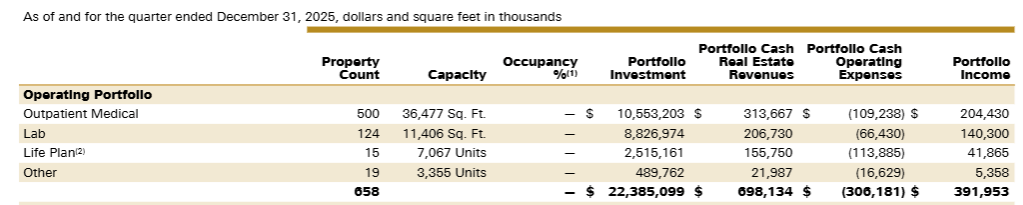
Each of these sectors trades at significantly different valuations.
Labs are troubled presently with oversupply and trade at the lowest multiple. Alexandria (ARE) is a nearly pure-play lab REIT so it serves as a good approximation of the market multiple on labs.
Healthcare Realty (HR) is the closest to a pure-play MOB REIT, and Welltower (WELL) while not pure senior housing, trades at its high multiple almost exclusively on its senior housing prospects.
S&P Global Market Intelligence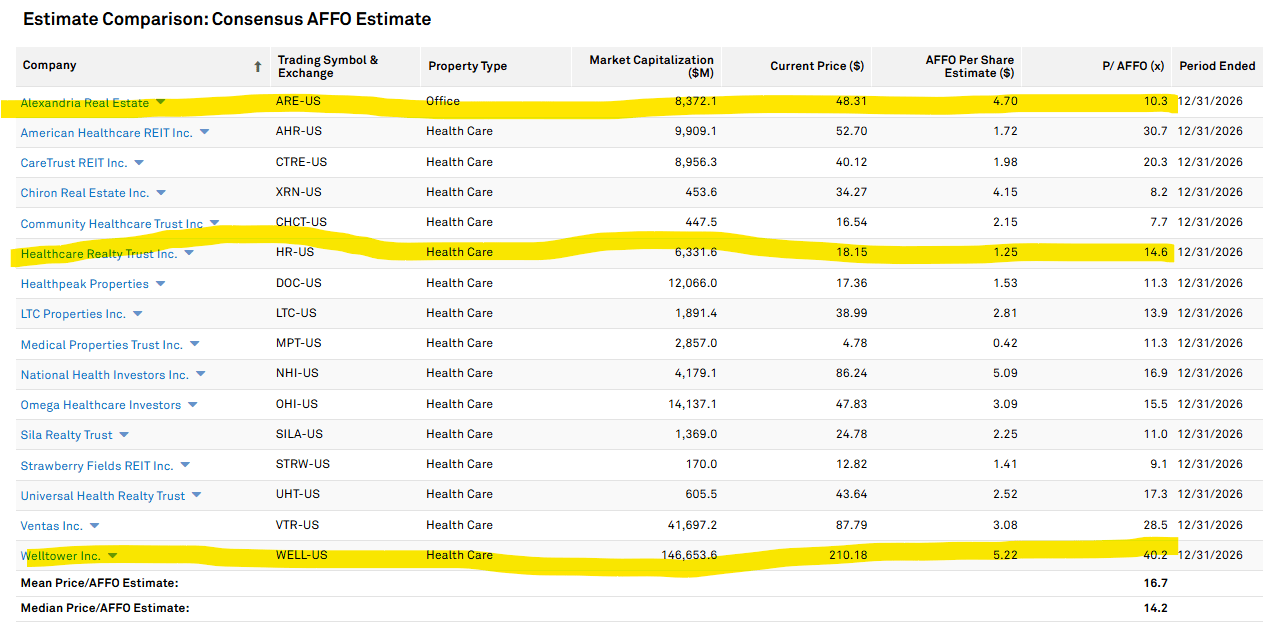
As seen above these lab, MOB and SH comps trade at 10.3X, 14.6X and 40.2X AFFO, respectively.
Healthpeak trades at 11.3X AFFO, right between lab and MOB multiples. On an AFFO multiple basis it would seem DOC is not getting any credit for its SH.
Net asset value tells a similar valuation story.
Labs trade deeply discounted to NAV with Alexandria at 52.5%. Medical office, as measured by HR trades at 90.8% of NAV and senior housing proxy Welltower trades at 208% of NAV.
S&P Global Market Ingelligence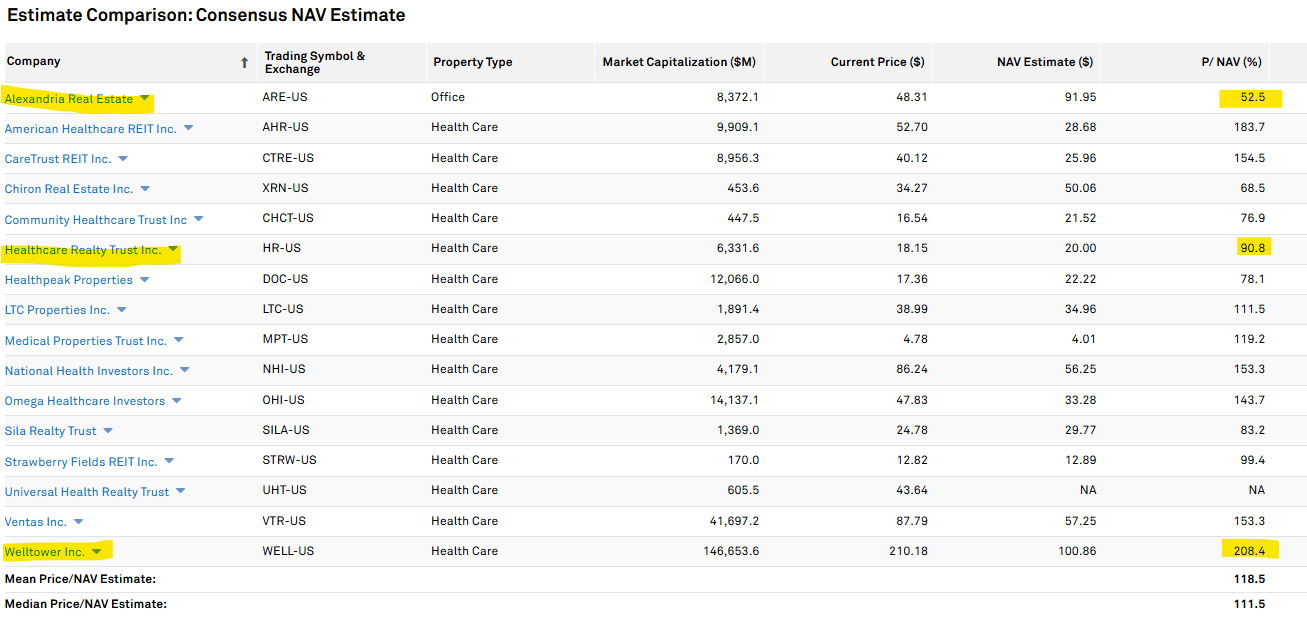
Once again, Healthpeak trades right between labs and MOBs. DOC’s price to NAV is 78.1%.
On both valuation metrics, DOC is clearly not getting credit for its large and strong senior housing portfolio.
Senior housing portfolio worth about $4.25 billion
The capital invested figures presented earlier do not properly show the ratios of current day value. Labs have lost value, MOBs have roughly held value, and senior housing has substantially increased in value.
That roughly $3B DOC invested in senior housing is worth closer to $4.25B today.
Specifically, DOC’s SH portfolio consists of 10,422 units across 34 communities with pro forma revenue of $771.2 million.
Prospectus
These communities are mostly entry fee based where residents pay a large (~$150,000) fee up front to live in the community and then move up the acuity chain as they age. DOC collects continued rent and medical revenues in addition to the upfront entry fee.
As a part of DOC’s larger portfolio, the SH revenues were overlooked. As a standalone IPO, however, they fetch a much higher multiple. They are targeting an IPO price for Janus Living (JAN) of $18-$20.
We see this price as extremely plausible as the offering is already well subscribed.
Per a Reuters report: “investors CenterSquare Investment Management, DWS Group, MFS Investment Management, and PGIM have indicated interest in buying up to $300 million worth of Janus shares from the offering”
Those investors alone account for nearly half of the IPO which is intended to raise $635.5 million in net proceeds or a bit more if the greenshoe is exercised.
As such, we will be using the midpoint ($19 per share) as the basis of our calculations on the valuation of Janus.
37 million A-1 shares are to be offered in the IPO (plus a greenshoe).
2nd Market Capital
Healthpeak will also own 78.9% of the Class A-1 shares and 100% of the 75.9 million A-2 shares. There are slight differences in voting power between the shares, but for valuation purposes, it is the total combined number of shares that we will be looking at.
DOC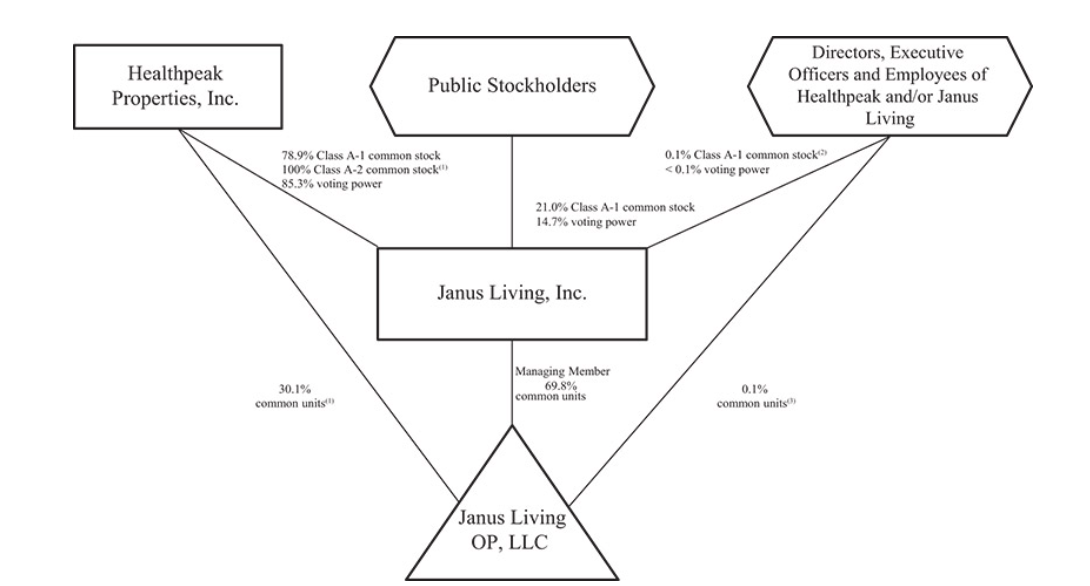
All-in there are to be a total of 251.9 million shares of JAN. Using the midpoint offering price of $19 that is $4.787 billion.
2nd Market Capital
Netting out cash of $632.5 million raised in the IPO and adding back $102 million of property level debt, this implies the senior housing assets are valued at $4.257 billion.
Now let us examine this valuation in relation to the contributed senior housing assets.
They have the following financial metrics:
- Pro forma estimated NOI of $199.6 million
- AFFO of $170 million
- Recurring capex of 29.9 million
- AFFO inclusive of capex of $140 million
These metrics spot the IPO pricing at the following valuation levels.
2nd Market Capital
The cap rate seems slightly on the low side. CBRE figures spot the average cap rate for class A senior housing at 6.1%.
CBRE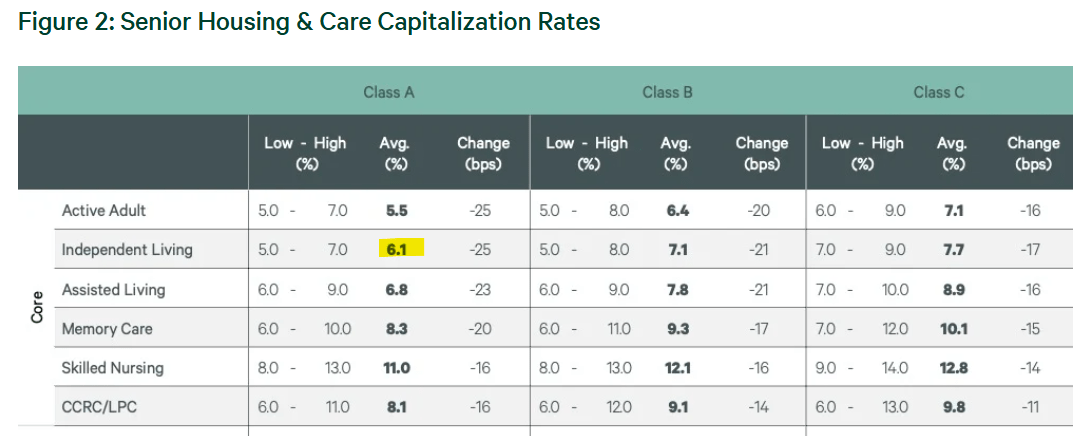
This report was from December of 2025 and senior housing cap rates have been trending downward. I suspect they are now in the 5s, but 4.69% for the DOC portfolio would indicate its properties are of significantly higher quality.
Implied enterprise value per unit is also significantly above recent comps.
Senior housing acquisitions by National Health (NHI), LTC Properties (LTC) and Brookdale Senior Living (BKD) were at price/unit ranging from $108K to $270K.
2nd Market Capital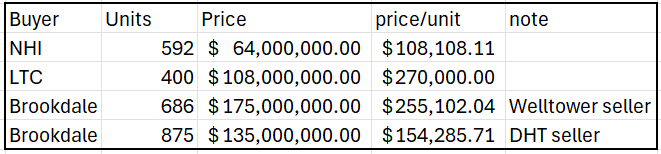
Thus, the $408K implied enterprise value per unit is well above average.
Differences can exist due to type of community. DOC’s entrance fee life plan communities are particularly high quality which shows up in the profitability metrics.
AFFO per unit is quite high, resulting in a normal looking AFFO multiple despite the high price tag per unit. JAN at the midpoint of the IPO range trades at 25X pro forma AFFO or 30X strict AFFO.
That is quite a bit cheaper than Welltower’s 40X multiple. However, as previously discussed, I do believe Welltower is substantially overvalued. 30X, in my opinion, is much closer to a proper senior housing multiple.
Overall, I find the Janus IPO price range to be slightly ambitious, but given how well subscribed the offering already is, I think it will be spot on.
Successfully IPOing at this price would be a big win for DOC.
DOC is currently valued as if it were just a MOB/lab REIT. The market will suddenly be forced to recognize its $4.25B of senior housing, in my view.
Going forward
Janus is poised to hit the ground running. They already have acquisitions lined up to immediately put the IPO proceeds to work.
DOC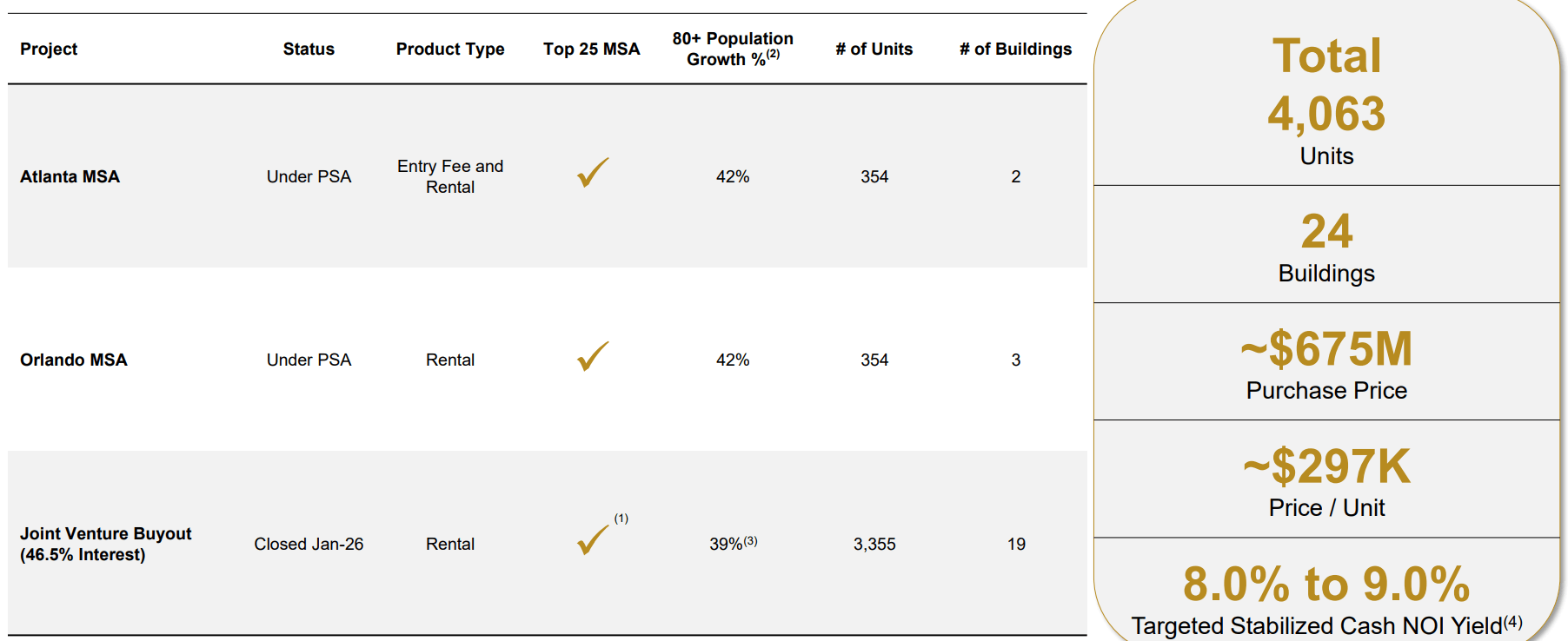
As Janus grows, the value will accrete to DOC as the shares will be held on its balance sheet for at least a year due to lock-up.
Risk factor – AFFO accounting awkwardness
When REITs hold shares of another company, the accounting gets a little wonky.
With the senior housing assets directly owned by DOC, all the AFFO produced by the properties showed up in DOC’s AFFO.
As the properties are fully spun out into Janus, the property level AFFO will no longer show up on DOC’s AFFO line. While DOC will still owns them due to its ownership of Janus shares, earnings of Janus do not flow through to DOC earnings.
To my knowledge, there are 2 main ways held shares will affect DOC earnings:
- DOC can elect to earn changes in the value of the stock. If Janus stock goes up by $1 per share in a quarter, DOC can record earnings equal to ($1 * shares held). Similar negative earnings would be recorded if Janus stock drops in a quarter.
- Dividends from Janus can be collected as DOC earnings.
Thus, DOC’s earnings are likely to be adversely impacted in the near term. Unless JAN adopts a very aggressive dividend policy, which I think is unlikely, recorded earnings from JAN shares will be less than the AFFO generated by the assets.
This doesn’t matter in actual value. DOC still owns the assets through owning JAN. It can, however, significantly impact the market price of DOC depending on how well it is communicated and how willing the market is to dig through the numbers.
The bottom line
DOC is about to get credit for substantial senior housing value that was previously ignored. While there will be unpredictable reception as the dust settles, I think it will be a clear win by unlocking the value in the long term.