

What starts as a dramatic horror story quickly becomes something else, though, with a far more emotional core and sense of humanity to the characters that elevates Heel into a far more effective exploration of humanity. During an interview with Screen Rant, Stephen Graham, Andrea Riseborough, and Anson Boon reflected on the uniqueness of the film and bonding on set.
Why Stephen Graham, Andrea Riseborough, And Anson Boon Needed To Be In Heel
“Stephen had it first,” Andrea Riseborough revealed, explaining that she was already working with director Jan Komasa on another project when Stephen Graham approached her about co-starring in Heel. “Stephen loved it, so I knew it was going to be brilliant. So many things come to us, and it is so rare that you love something so much that you stick with it as long as Stephen did. I read it, and it was just sublime.”
What was so brilliant about it was that these people form real relationships and much-needed connections — but it’s in all the wrong places… they’re genuinely relying on each other to get through this grief, because they’re going through the waves of it. Grief comes in its own time. You can’t plan it. It’s like the sea. It comes in and out. It’s like a tide that takes you, and you have to go with it, and you have to be respectful of when it’s about to bubble up in you.
Graham loved the script for Heel, but it also wasn’t the first thing that caught his attention about the project. It was the presence of Jan Komasa that really caught Graham’s attention. “I got a letter from Jan explaining this piece, and I hadn’t heard of him. Then I watched Corpus Christi, and I was blown away. I phoned Jan straight away, then our agents. Mine went, ‘Have you read the script yet?’ I said, ‘No, I haven’t read the script, but I’ve seen his film, and I’m in. I want to be a part of that.'”
Chris and Kathryn are very complex characters, especially as the film’s initial touches of horror give way to far more unsettling and emotionally interesting places. It’s also what really caught Graham’s attention as an actor, with the star noting that a character like Chris “was something I’ve never played before. I think as actors, we always say we want roles that bring something else to the table, that put us in a place to wonder if we can do this.”
I’m paraphrasing, but I think it was David Bowie who said, when you’re in the water, keep going until that point where your tiptoes are just touching the safe ground, and then just keep going a bit more. That’s when you find true freedom and true expression. For me, that’s what this was. I kept thinking, ‘Am I capable of doing this?’ This is a kind of character I’ve never really played before, and a side of Stephen that I’ve never been able to express.
That script was the north star for Anson Boon, who had a different challenge in Heel. On paper, audiences should immediately sympathize with Tommy, given that he’s a young adult kidnapped and held captive by Chris and Kathryn. However, Boon turns the street punk into a wholly unlikable mess, complicating the film’s purposefully tricky morality. “When you’re making a film,” Boon explained, “you’re so focused on the material that you have in the script and fleshing out your character, it can be a real surprise when you actually watch it.”
I was really surprised by this grim fairy tale aspect to it. Making it, I spent most of the film chained up in the basement, so it didn’t feel that way while shooting it [Laughter]. But watching it, there’s kind of this whimsical nature to it. I remember really being struck by the fact that it felt so unique. So often, there are these binary aspects to films, where you’re a goodie or a baddie. You have the protagonist and the antagonist.
With this film, I remember reading it and thinking, ‘Oh, I’m kind of rooting for this terrible person, and I’m also rooting for these good people doing terrible things. It’s this strange toss-up. It’s all there in the script. I read what’s on the page, and the character is very much created for you. As an actor, you can have fun fleshing that out in whatever way you see fit, but I’m always interested in diving into the head of a character and figuring out why they do the things that they do. That’s not necessarily just for a bad character; everyone does everything for a reason. With Tommy, I really wanted to get into that headspace and think about why he behaves like this. Why is he like this in the real world?
Finding Family, Limitations, And Surprises In Heel
Stephen leapt at the chance to bring Andrea into the project, even getting the chance to play a married couple again — albeit a far different one from the pair that appear in Matilda the Musical. Describing her as an absolute joy to work with, Graham could help himself from getting lost in her performance while on set during the production of Heel. “She’s searching for the truth. I love that we wouldn’t move one foot forward until we find the truth as a collective, and then we go there together on that journey.”
Graham specifically recalled one scene, watching Andrea just “glide through the kitchen like a ghost, and the camera was behind me. I’ll be dead honest with you. I love acting, and I love actors when they’re on it, you know what I mean? So, because I know the camera was behind me at the camera, I could just watch her and go “Hell, that’s magnificent. Wow.’ And she turned around, and I went, ‘Oh! Right! I’m in this! [Laughter].”
Graham and Riseborough were complimentary to their entire cast, but especially Anson Boon, with the former noting that “‘I’d never met Anson before [Heel]. I’d never seen his work, but he really excited me as soon as I got to know him. He’s such a wonderful young man. He’s just finding his way into the industry, and he’s exceptionally talented, and in this role, he’s phenomenal. His journey is huge, and he does it so well.” Graham was just as kind when speaking about Monika Frajczyk and Kit Rakusen, calling them brilliant in their own ways.
“What was really wonderful to discover,” Riseborough recalled, “was that when we were in the situation, we did become like this strangely fortified family. At the beginning of every scene, we had to get ourselves on the same creative page. That was a very unique experience, because that doesn’t always happen. Filming is fast and furious. It becomes a very intense process. You don’t always have time to dive into everything. At the beginning of each piece of Heel, we had to commune. We really felt solid and strong with each other.”
Graham concurred, revealing that “we sat and had dinner downstairs in the hotel. We watched football and stuff.” It even reached a point where Anson would be absent from a dinner, and the pair would get annoyed with him in the same way a parent gives the side-eye to a teenager. With a laugh, Riseborough remembered giving him a parental “Where have you been?” comment when he was late getting back to the hotel one night.
There was a person deep down in him who wanted to be loved, even if he would never admit it.
Looking back at the experience of making the film, Boon reflected on how, over the course of the story, Heel focuses on “two different characters with Tommy. The one at the beginning of the film and the one at the end are totally different people. Obviously, the methods they use on Tommy’s rehabilitation are totally unorthodox and wrong. But it gives me high hope that deep down in Tommy, and what I always liked about the character, was that there was a person deep down in him who wanted to be seen and wanted to be heard and wanted to be loved, even if he would never admit it.“
Beyond the emotional depth, Boon also noted that the chain that attached to Tommy was also a somewhat unique challenge as a performer to work around. “I never could have predicted just how limiting and debilitating that would really be, until I actually put it on. The script gave you this feeling of claustrophobia anyway, but when you actually put that on and realize just how helpless the character is in the hands of this couple. That was a big shock, but one that really helped me play the character.”
Luckily, it’s just a film. I wasn’t trapped in it. But you want to feel those things as an actor. It’s funny; as an actor, you always have a conversation with yourself about how deep into a character you can get before something just becomes not practical. I’m so glad with Heel that we managed to come up with this amazing, safe, but really effective collar that, as the actor, allowed me to feel that sense of restriction that the character would feel in real life.
That unique energy and surprisingly optimistic core are central to what the filmmakers are going for with Heel. It’s a powerful and surprisingly emotional thriller that Graham knew, even on set, was something special. “Whatever this is that we’re doing in this studio in Poland, it’s really interesting, and I’m really invested in it. I love it, because every single person was bringing something wonderful and unique to the table.”
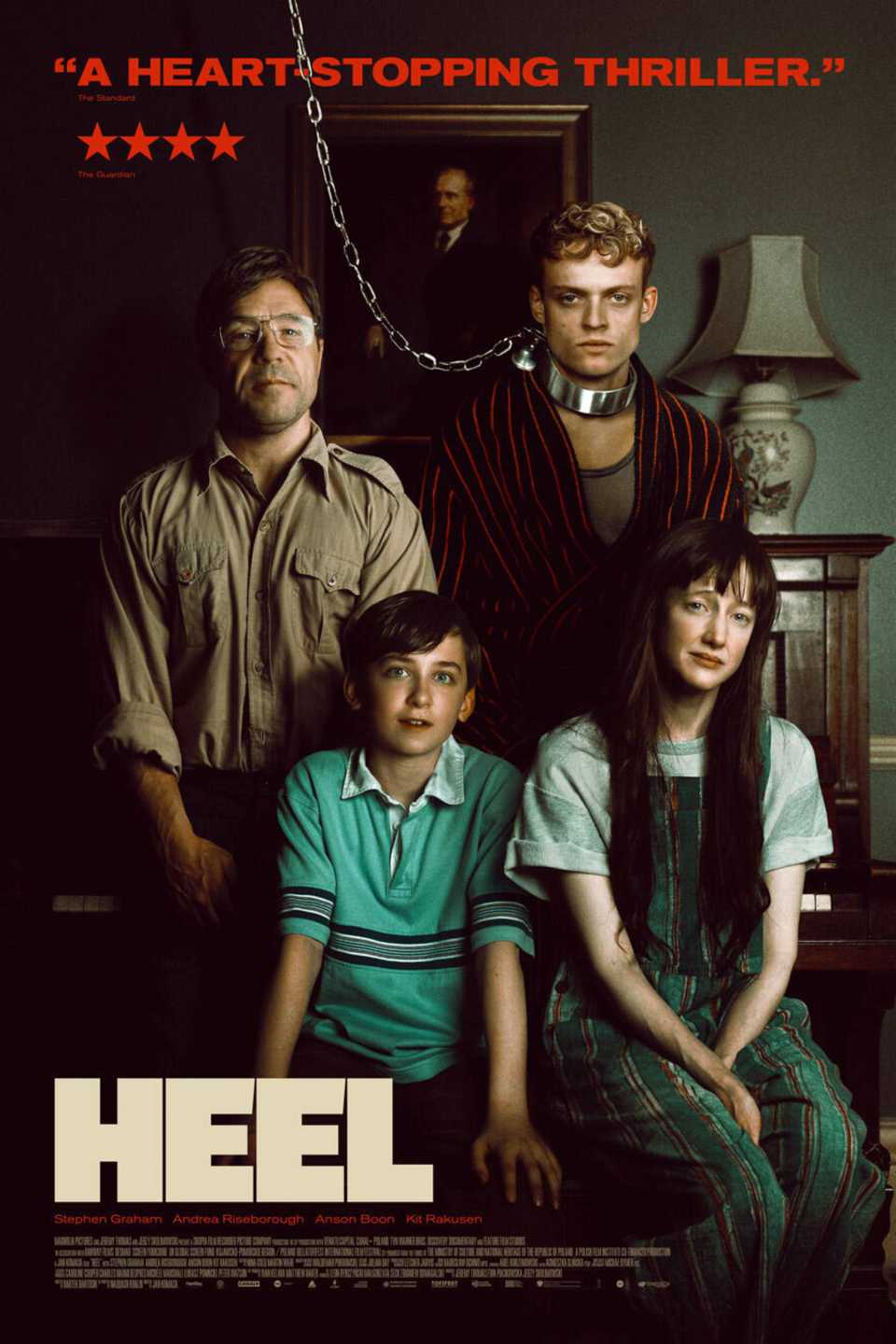
Heel

6/10
- Release Date
-
March 6, 2026
- Runtime
-
110 Minutes
- Director
-
Jan Komasa
- Writers
-
Naqqash Khalid, Bartek Bartosik