

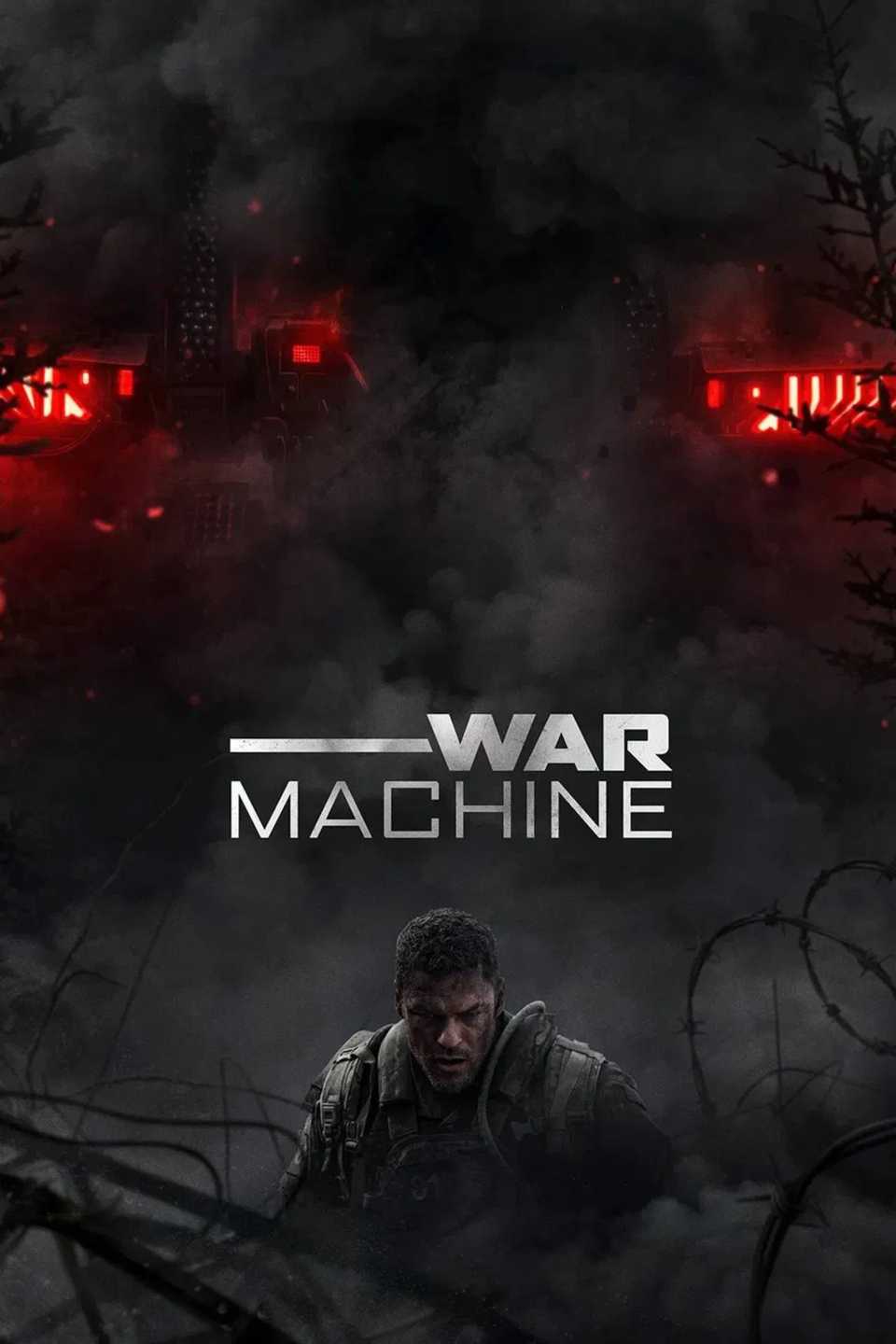
War Machine ends with its eye firmly on the future. After having released only in Australian theaters in February, the new sci-fi action movie from director Patrick Hughes dropped on Netflix globally on Friday, March 6. It follows star Alan Ritchson as Army Rangers candidate 81, whose final test to join this branch of Special Forces gets suddenly deadly when he and his fellow finalists mistake a mysterious, advanced-looking aircraft for their mission target. Instead of disposing of a glorified prop, they find themselves hunted by a killer robot sent to Earth from an asteroid that recently entered our orbit.
81 ultimately manages to defeat the machine, but not before his team is utterly decimated. In the end, only he and 7 (Stephan James), the squad’s original leader, survive to cross the RASP seal and complete their assessment. But, it turns out, completing Death March is hardly the end of 81’s troubles.
War Machine Ends With The Threat Of An Full-Scale Alien Invasion (& A Sequel?)
When he returns to base, Ritchson’s hero learns that his robot was one of many. As correctly posited on the newscast 81 watched earlier in the film, the oddly behaving asteroid was not one single object, and it fragmented into several of these killing machines that landed in different places around the globe. While he was fighting one in the mountains, the Rangers were dealing with their own back at base, and lost half the battalion before finally securing it. This explains why no one came looking for the candidates after contact with both them and cadre was lost.
The world’s militaries managed to defeat the “first wave,” but at great cost of lives and resources – and a whole lot more are headed our way. According to another newscast, interstellar imaging has revealed tens of thousands more objects like the initial asteroid approaching Earth. Governments have formed a global coalition to prepare for the coming invasion, but given how the first round went, it’s clear this threat will push humanity to its limit.
Setup for a potential War Machine 2? Maybe. The powers that be undoubtedly want to see how the movie performs on Netflix before exploring this as a potential franchise, but Hughes and Ritchson confirmed to SR that a sequel (referred to as War Machines, in a nod to James Cameron’s Aliens) has been completely mapped out. If this ending is any indication, it would be much bigger than this relatively contained action movie. After this promise of an alien invasion, a War Machine sequel would need to significantly increase the sci-fi scale – as well as the budget.
What’s Next For 81 After Surviving Death March?
Though it ended up being far more difficult than he imagined, Alan Ritchson’s 81 does what he set out to do: cross the RASP finish line. Army Sergeant Major Sheridan (Dennis Quaid) puts the Rangers scroll on his uniform himself. But as Army Officer Torres (Esai Morales) warned him, that finish line is really a starting line, and he’s beginning his Ranger career in the midst of an extraterrestrial attack. Even after what he just went through, a bit of rest doesn’t seem to be an option.
After passing on what he learned about the machines’ ventilation system that allowed him to defeat one without traditional weaponry, 81 is immediately thrust into Operation Global Shield, a massive mobilization of the world’s fighting forces to prepare Earth for what’s coming. War Machine doesn’t get into the details, except that the Rangers have been tasked with evacuating civilians from an unspecified city to create a path for heavy ordnance to be stationed there. 81 joins the ranks of soldiers loaded into Black Hawk helicopters and ends the film en route to his next mission.
However, War Machine also suggests he’s destined for more. From the beginning, Torres and Sheridan have pushed 81 to step up and lead, seeing his obvious promise as well as the mental anguish holding him back. He gets another test when he’s asked to speak in front of the Rangers before they deploy, and though he doesn’t exactly give the most rousing speech, he gets more comfortable as he goes and it does the job. The camera lingers on his commanding officers intently watching him leave, and then gives him the hero treatment, making Ritchson the only Ranger without a helmet as they all run in slow-motion to their transports.
The movie ends with a feeling of destiny around 81. With the combined stories of his survival in Afghanistan and his single-handed defeat of an alien robot, he’s already becoming a known figure among his peers, and he seems destined to grow into a position of real leadership. In all likelihood, he’ll play a key role in the war to come, and possibly end it as a living legend.
The True Meaning Of War Machine’s Ending
War Machine isn’t hiding a bunch of hidden messages or deep symbolism – the closest it comes to supporting that kind of reading is doubling as a US Army Rangers recruiting commercial, and it’s hard to justify calling that “hidden.” But underneath all the slo-mo and swelling music, the movie does tie a neat, revealing bow on 81’s arc.
Throughout the film, 81 insists his reason for attempting RASP is to cross the finish line, and his unfulfilled promise to his brother is clearly motivating him. Two key moments flesh this out. In the first, after being called a war hero by 15, we learn that 81’s brother died from his injuries in Afghanistan after Ritchson’s protagonist was unable to carry him all the way back to base. Despite making it miles through the desert on a wounded leg, he passed out just 100 yards from the perimeter. Symbolically, crossing the RASP finish line is an opportunity to revisit and overcome that trauma.
In the second, 81 learns that 7 had met his brother, and had known the truth of what happened to 81 the whole time. In a moment of vulnerability, 81 admits the connection between his brother’s death and RASP. He believed that if he could cross the finish line for him this time, the nightmare of that day might finally fade, and he could actually get some sleep.
War Machine‘s ending suggests that he was only half right. In a direct mirror of his past, 81 successfully carries the injured 7 back to base and to the finish line, where he receives medical care. But this is not the moment he experiences psychic release. That instead comes after he accepts the responsibility of being a Ranger, gives a pep talk to his fellow soldiers, and leaves for his next mission. As the helicopter takes off, 81 flashes back to receiving a hug from his brother; the moment has lost its immediate pain. When we see him next, he’s fast asleep.
It may seem small, but this choice is quite impactful, and speaks to the larger theme of the film. 81’s belief that he can resolve his past and ease his pain doesn’t prove true, even when the parallels become far stronger than he ever imagined. Instead, he found relief after he acknowledged a need for change in himself and accepted the possibility of moving forward. Completing RASP wasn’t enough to keep his promise to his brother – he had to become the kind of person his brother dreamed they would be.
- Release Date
-
March 6, 2026
- Runtime
-
107 minutes
- Director
-
Patrick Hughes
- Writers
-
Patrick Hughes, James Beaufort
- Producers
-
Todd Lieberman, Alexander Young, Patrick Hughes, Greg McLean, Rich Cook