
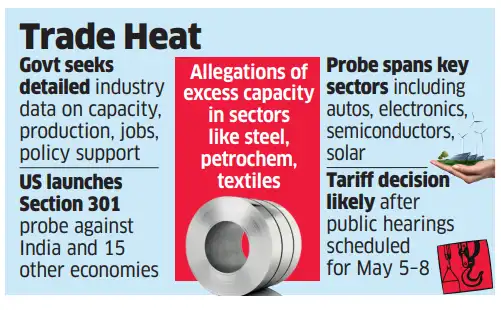
The United States Trade Representative (USTR) initiated investigation concerning the acts, policies and practices of various economies relating to structural excess capacity and production in manufacturing sectors to examine whether such practices were unreasonable or discriminatory and whether they burden or restrict American commerce. “We are evaluating and examining the legal impact of the investigations launched by the US against India under Section 301(b),” said an official. The government has sought data on ownership profile of the industry such as whether majority share is held by private or public stakeholders, and domestic and foreign participation.
China, the EU, Japan, Vietnam, Bangladesh and others are among the 16 economies under investigation. “The government is working on timely and evidence-based submissions from the industry as there are potential implications for India’s exports and overall trade relations,” said an industry representative.

Details related to capacity, production and utilisation from FY20 to FY25, the kind of policy support such as production linked incentive scheme, tax subsidy, export incentive and preferential credit, India’s share in global production of the respective products and global output of the goods, have been sought.
India’s February goods exports to the US fell 12.88% from a year earlier to $6.89 billion, reflecting the impact of high tariffs imposed on the country. Imports from the US rose 36.5% last month.Under Section 301, President Donald Trump may impose tariffs if the USTR determines that a trading partner has engaged in unfair trade practices. Washington launched the investigation after the US Supreme Court on February 20 struck down Trump’s earlier tariff regime.
Industry associations have also been asked for job information including direct and indirect employment, and linkages with the micro, small and medium enterprises in their respective sectors.
On Global Value Chain (GVC) Integration, the firms must specify the share of imported products and linkages with American companies. The firms also have been asked if they operate in upstream, midstream, or downstream activities such as raw material sourcing, manufacturing, assembly, or distribution.