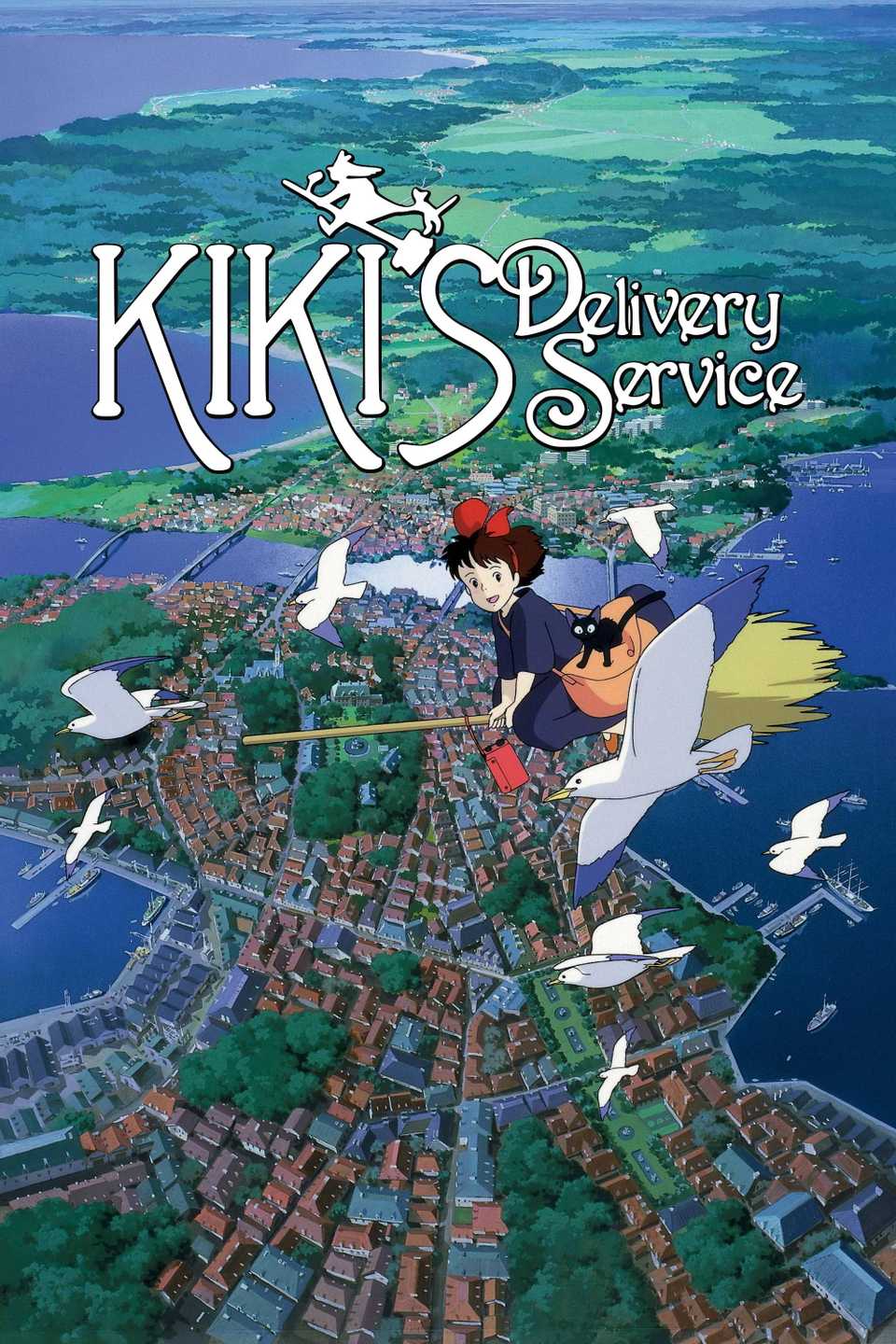
The charm of this 1989 Studio Ghibli film comes from its relatable themes of the burden of everyday human experience, told through a young girl’s journey toward independence. Beyond its animation, which helped define what audiences would come to associate with the “Ghibli style,” Kiki’s Delivery Service‘s focus on Kiki’s personal growth and her resilience in a new environment remainscompelling decades after its original debut.
Kiki’s Delivery Service Is A Simple Slice-of-Life Film In Magical Packaging
Kiki’s Delivery Service follows 13-year-old Kiki (voiced by Minami Takayama in the original Japanese version and by Kirsten Dunst in the English dub) as she navigates the difficult road toward independence. She lives in a countryside town with her “normal” dad, Okino (Kōichi Yamadera/John Dantona), her witch mother, Kokiri (Mieko Nobusawa/Barbara Goodson), and her sardonic black cat and familiar, Jiji (Rei Sakuma/Phil Hartman).
In Kiki’s countryside, magic is neither mysterious nor feared, but warmly embraced by the community. Kokiri’s herbal remedies aid the sick, and the townspeople cheer at her daughter gliding on a broomstick. Kiki’s adventure begins with a longstanding tradition: 13-year-old witches leave home for a year to train and forge their own path in a witch-less town. Dutifully following this custom, Kiki departs one night astride her flying broomstick, with Jiji by her side.
If only the warm, vibrant look of Kiki’s new city matched its reception of her, this film would have taken a different turn. But, alas, not all people in this world are used to magic. Kiki has a hard time blending in, and the townsfolk greet her with suspicion and indifference; at one point, she nearly runs afoul of the police. She also struggles to find a place to stay until a kind, pregnant baker named Osono (Keiko Toda/Tress MacNeille) offers her a small room above her bakery, Gütiokipänjä. Kiki may be a witch, but she isn’t immune to the clumsiness she likely inherited from her father. Still, she can fly. And she puts it to good use, eking out a livelihood by delivering packages and Osono’s pastries across the city on broomstick.
Miyazaki Preaches Independence, Self-Confidence, & Adaptability In Kiki’s Delivery Service
Kiki’s Delivery Service can almost be viewed as the reverse of stories like The Chronicles of Narnia, Alice in Wonderland, or Miyazaki’s own Spirited Away. In those stories, ordinary children enter magical worlds. Kiki’s situation is the opposite: She is magical in a non-magical town, and must deal with the loneliness, awkwardness, and sense of displacement that comes with it.
There are no evil witches to be defeated, no entrenched societal conflicts to navigate, and no tyrants to be overthrown. Rather, Miyazaki’s advice to kids and teens is that it is perfectly normal to feel both excitement and fear in the face of change, but self-confidence and perseverance must ultimately anchor those emotions. Kiki experiences the uncertainty of living alone for the first time, the embarrassment of making mistakes in front of strangers, and the creeping doubt that she might not be as capable as she once believed.
Unfortunately, many of Miyazaki’s themes in this film cannot be fully grasped by the target audience. What does a 13-year-old – whether in 1989 or in 2026 – truly understand about depression? Or the insecurities that arise when Kiki compares herself to more confident peers, like the stylish city girls who view her as strange? Or the frustration and burnout that comes from trying so hard not to disappoint the people who depend on her deliveries?
What likely won’t fly over a younger viewer’s head, however, is the film’s celebration of the friendships and connections that make life worthwhile. Aside from the loving Osono, Kiki meets a host of memorable characters in the new city: Tombo (Kappei Yamaguchi/Matthew Lawrence), a dorky lad obsessed with aviation; and Ursula (Minami Takayama/Janeane Garofalo), a painter living in the forest. A conversation with the latter about losing her “spark” when she loses her ability to fly and even to understand her cat Jiji, reveals the importance of some reclusiveness when life comes baring its teeth.
Miyazaki’s role hides his take on life even in the very fabric of Kiki’s new seaside city. Thanks to Studio Ghibli’s meticulous craftsmanship, it is beautifully realized, with architecture and waterfront streets that ring a European bell (particularly Stockholm). It’s difficult to pinpoint the film’s exact time period. However, attentive viewers can reasonably place it somewhere between the early 1930s and the late 1950s. The world blends elements from multiple decades: 1930s-style airships drift through the sky, 1940s-era vehicles appear on the streets, and machinery reminiscent of the 1950s fills workshops and homes. At the same time, the setting portrays a peaceful Japan – one untouched by the devastation of a war that, in this world, seemingly never occurred.
Why this ambiguity exists remains unclear, and whether it was entirely intentional is open to interpretation. Still, it feels fitting. Much like Kiki herself, who glides freely above the city, Miyazaki’s storytelling refuses to be confined to a single moment in history, instead creating a timeless atmosphere of youthful adventure.
- Release Date
-
July 29, 1989
- Runtime
-
103 Minutes