
“For every $1 per barrel rise in crude price, OMCs’ auto-fuel gross marketing margin declines by ‘0.55 per litre (assuming no change in retail petrol, diesel price and excise duty on petrol and diesel) and drags down their consolidated Ebitda (Earnings Before Interest, Taxes, Depreciation, and Amortisation) by 7-9%,” said JM Financial Institutional Securities in a report adding that OMCs typically earn a gross marketing margin of about ‘3.5- 4 per litre on petrol and diesel when Brent is around $70 per barrel.
 Agencies
Flow chart Costlier crude impacts price spreads and also worsens LPG under-recoveries
Nomura Financial Advisory and Securities expects integrated margins, which include refining, fuel marketing and LPG under-recoveries, to decline by around $3-4 per barrel at the current crude oil prices for IOCL, HPCL and BPCL compared with the previous quarter.
Higher crude prices also worsen LPG under-recoveries, which eat into OMC profits. Nomura highlights that LPG under-recoveries have more than doubled to ’69 per cylinder in the March quarter till date from ’33 per cylinder in the previous quarter. Since LPG prices are subsidised, any increase in crude oil costs pushes OMCs’ LPG under-recoveries higher.

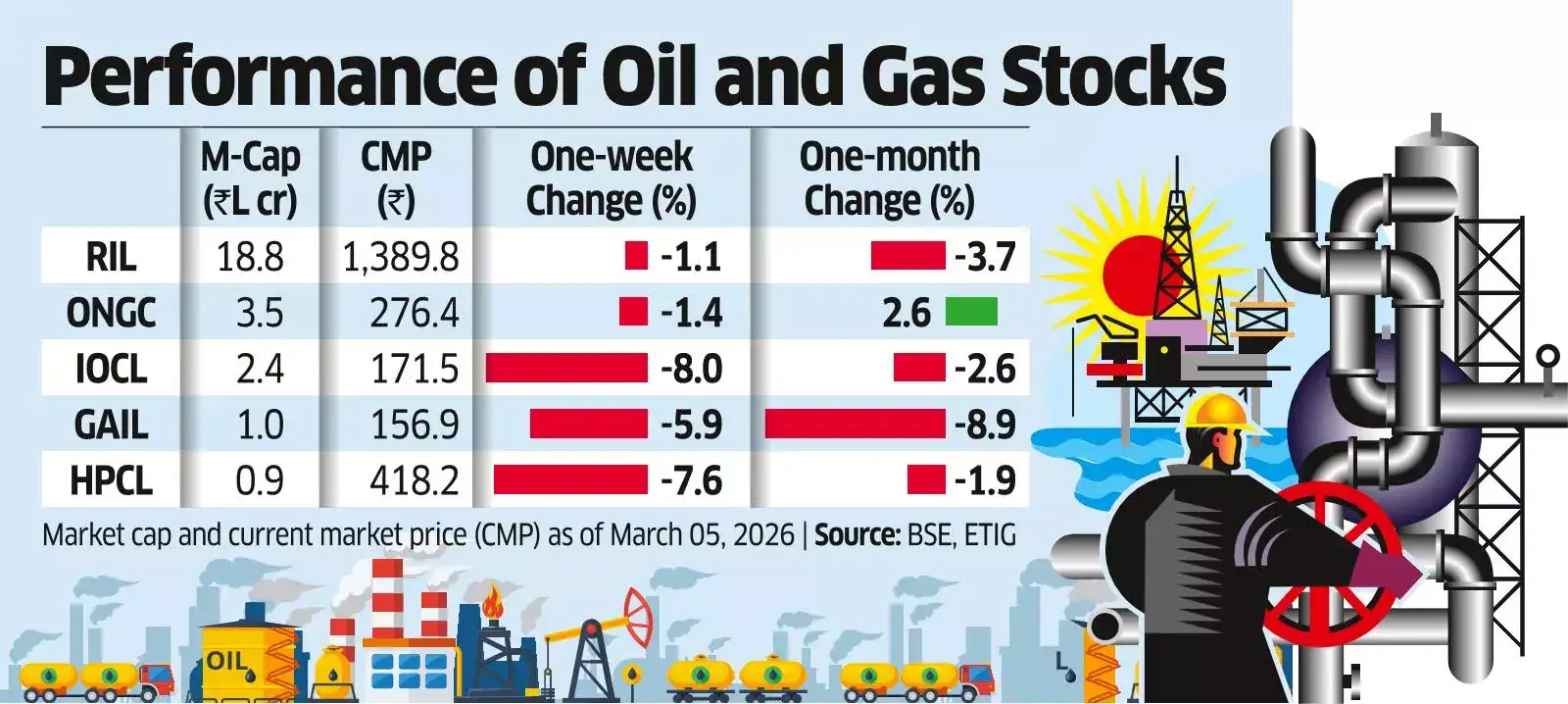
Upstream companies including ONGC and Oil India, which benefit directly from rising crude prices, are likely to see stronger earnings on the back of higher realisations. ONGC and Oil India would be key beneficiaries if Brent crude sustains above $70 per barrel, as every $1 rise in oil prices boosts their earnings by 1.5-2%, said JM Financial Institutional Securities. Spot LNG prices have more than doubled to $25 per mmbtu (Million British Thermal Units) after QatarGas announced a shutdown in LNG production on March 02. This is likely to affect gas utilities such as GAIL, Petronet LNG, Gujarat Gas and other city gas distributors since both volumes and margins are likely to come under pressure.