
Just_Super/iStock via Getty Images
Introduction To The VanEck Fabless Semiconductor ETF
The VanEck Fabless Semiconductor ETF (SMHX), which is backed by the New York-based investment management corporation VanEck, got listed on the 27th of August 2024 and has amassed total AUM of $150 million by the time of writing. SMHX has an expense ratio of 0.35% and makes distributions on an annual basis (every December), with the yield amounting to 0.02%.
What Does SMHX Do?
SMHX seeks to offer coverage of a narrow subset of US-listed semiconductor stocks that operate as fabless companies and does so by tracking the MarketVector US Listed Fabless Semiconductor Index (MULFSI).
Fabless semiconductors differ from the rest of the semiconductor pack in the following ways:
SMHX
The broad semiconductor universe can be broken up into four different pockets (foundries, IDMs, equipment manufacturers, and fabless entities), and the fabless cohort stands out because they have the most capital-light business model of all the four pockets.
These fabless semis devote most of their resources towards the research, development, and design of semiconductor chips, without worrying about the operational and logistical hassles and the financial burden of dealing with in-house production. The production of chip designs is outsourced and carried out by the foundries and the Integrated Device Manufacturers, or IDMs, who typically leverage the capital equipment of the semiconductor equipment manufacturers.
What Are The Main Features Of SMHX’s Portfolio?
The first thing to be said is that SMHX consists of a very narrow pool of semiconductor stocks (just 22 in total), so you’re bound to face some concentration effects. While SMHX’s tracking index looks to rebalance and cap its individual stock weights to 20% four times in a year (March, June, September, and December), we still have quite a top-heavy portfolio where just two stocks—NVIDIA Corporation (NVDA) and Broadcom, Inc. (AVGO)—jointly account for one-third of the entire portfolio.
Seeking Alpha
From a market-cap perspective, SMHX holds stocks from each market-cap bucket, but given that it tracks a market-cap-weighted index, the emphasis is still on giant caps (which alone account for one-third of the portfolio). Micro-cap exposure could potentially have been higher, but given that SMHX’s tracking index has set a baseline market-cap requirement of $150 million, a good chunk of the micro-caps wouldn’t have made the cut anyway.
Morningstar
Stylistically, the bulk of this portfolio (over 90%) consists of growth stocks (stocks that tend to see strong sales and earnings growth, stocks that witness strong price momentum).
Morningstar
What Are The Risks Associated With SMHX?
Investors typically gravitate to ETFs over single stock exposure, mainly because of the diversification effects. However, its top two holdings (Nvidia and Broadcom, currently) account for one-third of the entire portfolio, somewhat limiting the diversification objective. Since it’s a concentrated and top-heavy bet, this suggests that performance is reliant on just a handful of names, as opposed to if the holdings were equally weighted.
The prospects of the fabless semiconductors that SMHX covers are closely linked to the growing appetite of AI and spending associated with the AI wave. If the AI cycle seizes, or if investors were to start expressing concerns over the ROI (Return on Investment) associated with elevated AI spending, this could hamper SMHX more than other diversified semiconductor ETFs that also cover semiconductor stocks that are more exposed to traditional categories such as consumer electronics, automotive, defense, etc.
Seeking Alpha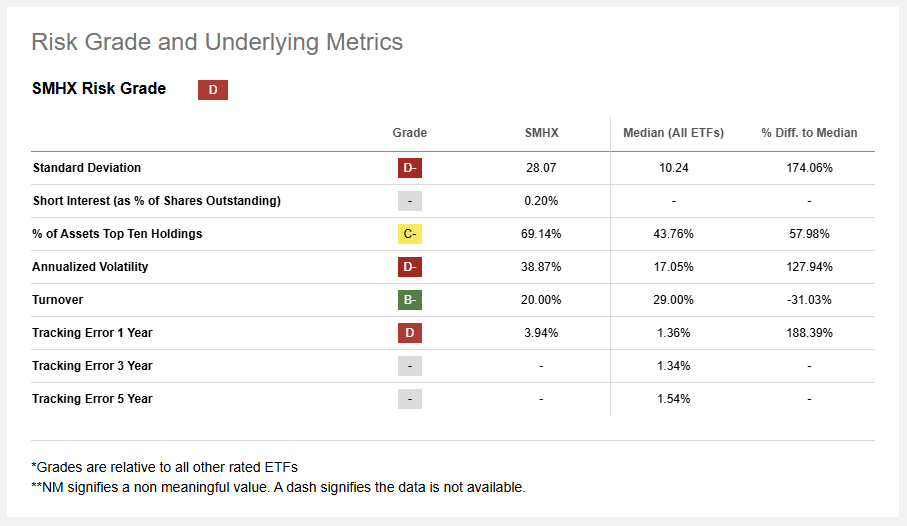
SMHX’s annualized volatility profile amounts to almost 40% and is more than 2x greater than the volatility that ETFs in general experience. This suggests that the returns that SMHX provides tend to be erratic; for added context, note that in 2025, between Q1 and Q2, we saw some wild swings, where SMHX had contracted by -20%, only to then recover by +34% in the following quarter.
SMHX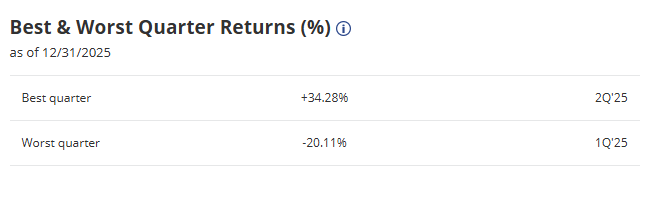
One could also say that SMHX is tied to US equities since its beta is 2.85, which means that for every 1% move in the S&P 500, SMHX will likely move by a threshold of almost 3% (generally speaking). When risk aversion in the market is high and the benchmark is facing pressure, SMHX could end up taking a more pronounced hit due to its heightened sensitivity to the benchmark.
YCharts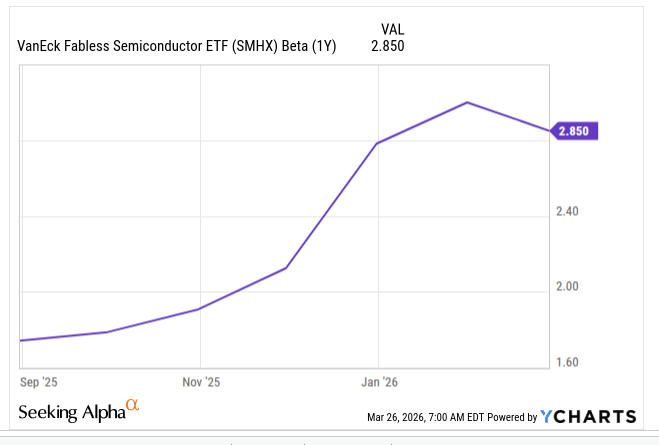
All this suggests that SMHX would be largely unsuitable for investors with conservative risk appetites and mainly suitable for those who are only prepared to view it as a satellite holding.
SMHX is still fairly new, but for an ETF that only needs to replicate the performance of 22 stocks from its tracking index (as opposed to 100s or 1000s of stocks), its tracking error of almost 4% (in its first year of operation). This is almost 3x more than the median ETF tracking error (of 1.36%).
The semiconductor industry, which is a classic growth sector, is not known for lucrative distributions, as excess cash is typically reinvested back into R&D and acquisitions. SMHX’s 2025 distributions contracted by -19% YoY, translating to an insignificant yield of just 0.02%, which makes it one of the lowest-yielding semiconductor ETFs.
Who Is SMHX For?
An ideal holder of SMHX would primarily be someone who wishes to invest in more asset-light, fabless technology companies that are in the business of leveraging their intellectual property. Investors who want to participate in the growing penetration of artificial intelligence will appreciate SMHX, as its holdings are keenly involved in the design of specialized and high-tech AI chips and accelerators. An emphasis on the outsourcing of the semiconductor fabrication process also means that investors of SMHX are those with high fixed asset turnover ratios (a low fixed asset base with strong revenue readings).
Investors who aren’t overly fussed about shelling out premium valuation multiples so long as they gain access to quality assets with high-growth prospects will also appreciate a portfolio like SMHX. We say this because SMHX, which is priced at a forward earnings multiple of less than 29x currently (which translates to a 10% premium over the Nasdaq 100’s corresponding multiple), is set to see long-term earnings growth of almost 24% (in contrast, the Nasdaq’s holdings lag quite considerably with long-term earnings potential of less than 14%). This, of course, can change over time depending on which companies are leading markets and have higher forward earnings multiples.
Morningstar
Which Are Some ETF Alternatives To SMHX That Are Worth Noting?
As of March 2026, SMHX remains the only US-listed ETF to offer focused pure-play coverage to fabless semiconductor stocks. If investors are open to looking for ETF options that aren’t overly fixated on just the fabless names, they may also want to take note of the State Street SPDR S&P Semiconductor ETF (XSD) or the Invesco PHLX Semiconductor ETF (SOXQ).
XSD is suggested as an alternative, as it offers a much wider coverage of semiconductor stocks SMHX (basically 43 stocks, which is almost double the number of stocks that SMHX covers). Crucially, unlike SMHX, whose tracking index follows a market-cap weighting protocol, XSD’s tracking index (the S&P Semiconductor Select Industry Index) assigns equal weights to its holdings, thus reducing the presence of strong concentration effects in the top stocks of its portfolio. The top two stocks only account for 6% of XSD’s portfolio (a stark contrast to the 34% weight of SMHX’s top two, or even SOXQ for that matter-22%). By pursuing XSD, investors will also get hold of a portfolio that tilts more towards small-cap semiconductor stocks (which could be seen as innately more volatile but with potentially higher long-term growth prospects).
SOXQ, which is more of a giant-cap play like SMHX, stands out mainly because it is one of the more cost-efficient ETFs in the semiconductor space with an expense ratio of just 0.19% (this is almost only half as much as the other two). This facet also means that it tends to see quite a lot of interest on a daily basis (dollar volumes account for $64 million per day, which is a whopping 20x more than SMHX and 5x more than XSD, which had been around for over 15 years before SOXQ got listed). Strong daily volumes also mean that the spread on SOXQ’s bid and ask is relatively tight, working out to just 0.03% in percentage terms, which is just one-third of the spreads SMHX encounters, meaning investors are unlikely to be encumbered by slippages. XSD in particular could be susceptible to slippage risk because of the wide bid ask of 0.17%. SOXQ also has an edge over the other two when it comes to the income facet, as it offers almost double the yield of XSD and over 20x more than SMHX.
Seeking Alpha, Morningstar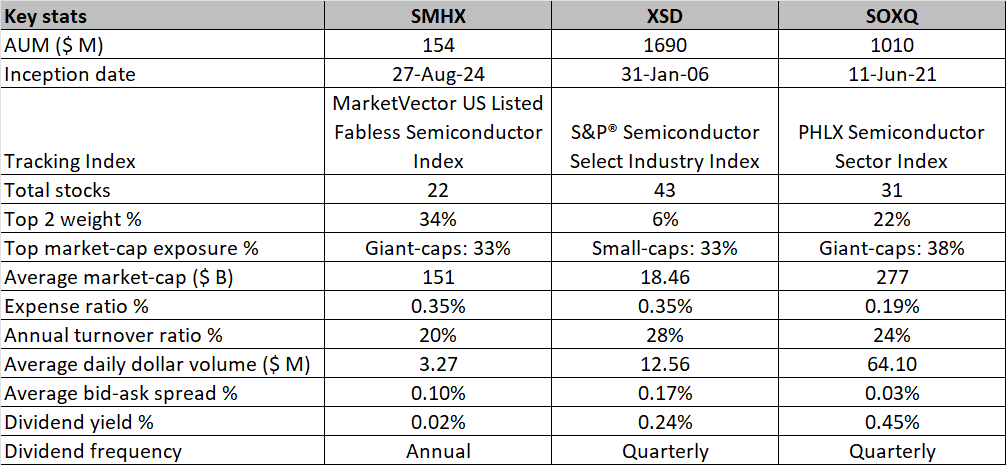
Summary
SMHX, which comes across as a highly concentrated and high-beta bet on the volatile semiconductor industry, would appeal to investors who like innovative, capital-light businesses that are at the heart of the AI wave and are staring at strong long-term growth prospects. SMHX’s distributions are a pittance, and for an ETF that covers only 22 stocks from its tracking index, its tracking error could be better.
This article answers three main questions about SMHX:
- What are the main features of SMHX’s portfolio?
- What type of investor is SMHX suitable for, and what are the risks associated with it?
- How does SMHX compare to other semiconductor ETFs?
Editor’s note: This article is intended to provide a general overview of the ETF for educational purposes only and, unlike other articles on Seeking Alpha, does not offer an investment opinion about the ETF.