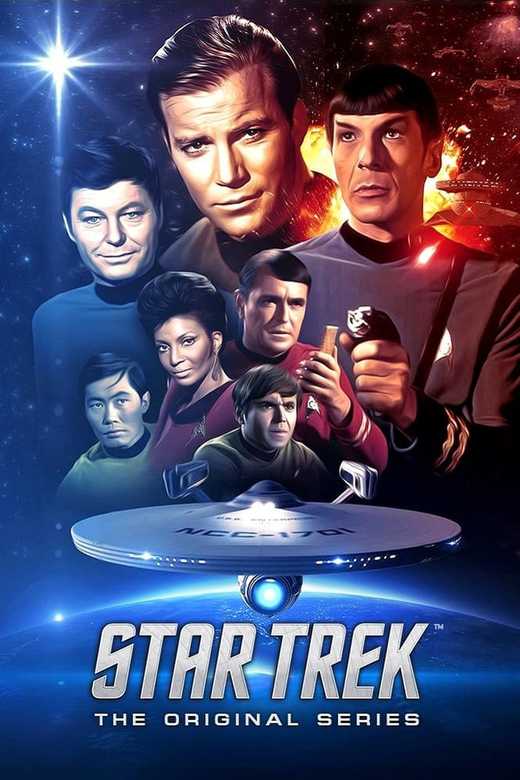
Star Trek has long indulged in Shakespeare and theater. Star Trek: The Next Generation‘s Captain Jean-Luc Picard was played by Royal Shakespearean Company icon Patrick Stewart. Several plays were performed aboard the USS Enterprise-D and its holodecks, including William Shakespeare’s Henry V, Charles Dickens’ A Christmas Carol, and Cyrano de Bergerac.
William Shakespeare has also been liberally quoted throughout Star Trek, perhaps most memorably in Star Trek VI: The Undiscovered Country. The villainous General Chang (Christopher Plummer) incessantly spouted Shakespeare’s dialogue that he swears is “better in the original Klingon.”
Star Trek’s bloodiest Shakespeare play of all, however, was the first time a play was performed on the Starship Enterprise.
Star Trek’s First Play Resulted In Tragic Murders
The first play ever performed in Star Trek was in the 1966 episode of Star Trek: The Original Series season 1, “The Conscience of the King,” and it was all about murder. In “The Conscience of the King,” Captain James T. Kirk (William Shatner) grew obsessed with proving that an actor named Anton Karidian (Arnold Moss) was a mass murderer from his past named Kodos the Executioner.
The Karidian Company performed parts of MacBeth and Hamlet in Star Trek: The Original Series “The Conscience of the King.”
Meanwhile, Captain Kirk was infatuated with Anton Karidian’s daughter, Lenore (Barbara Anderson). Kirk is too late to deduce that Lenore is also a murderer who killed everyone capable of identifying her father as Kodos, with Kirk targeted as her last victim. The murders most foul culminated in a deadly performance of Hamlet aboard the USS Enterprise where Lenore accidentally killed her own father.
“The Conscience of the King” is a memorable and thought-provoking example of classic Star Trek. Captain Kirk sets aside his gallantry in his pursuit of vengeance, and James’ amorous overtures towards Lenore, who is much younger, is also disturbing. Lenore herself is criminally insane, and her climactic psychotic breakdown is tragic despite everyone she killed to protect her father’s secret.
Star Trek: Starfleet Academy’s Play Was The Total Opposite Of Captain Kirk’s
Lieutenant Sylvia Tilly wisely avoided a blood-soaked play by William Shakespeare in Star Trek: Starfleet Academy episode 8. Instead, Tilly backs Series Acclimation Mil aka SAM’s (Kerrice Brooks) choice of Thornton Wilder’s Pulitzer Prize-winning play, “Our Town,” for the traumatized cadets to study.
Star Trek: Starfleet Academy episode 6’s title, “Come, Let’s Away,” is a quote from William Shakespeare’s King Lear (Act 5, Scene 3).
A tale of early 20th century small town America, with themes of life, young love, death, and appreciating the beauty in everyday moments, “Our Town” is the furthest thing from a Shakespearean tragedy. “Our Town” helped the cadets confront how their profoundly their lives changed by surviving Nus Braka (Paul Giamatti) and the Furies’ attack on the USS Miyazaki in Star Trek: Starfleet Academy episode 6.
When Caleb Mir (Sandro Rosta), Genesis Lythe (Bella Shepard), Jay-Den Kraag (Karm Diané), Darem Reymi (George Hawkins), and Ocam Sadal (Romeo Carere) finally embraced “Our Town,” it brought them a sense of peace and commonality that helped them bond. The cadets also welcomed the emotionally wounded Tarima Sadal (Zoë Steiner) into Starfleet Academy.
Star Trek: Starfleet Academy episode 8 was a powerful and resonant hour about grief and healing that feels even more relevant juxtaposed to how our real world that feels increasingly perilous and hopeless. The murder and madness of the first-ever play in Star Trek: The Original Series is the last thing Starfleet Academy’s cadets needed to move past their grief and regain their youthful optimism.
-

- Release Date
-
1966 – 1969-00-00
- Showrunner
-
Gene Roddenberry
- Directors
-
Marc Daniels, Joseph Pevney, Ralph Senensky, Vincent McEveety, Herb Wallerstein, Jud Taylor, Marvin J. Chomsky, David Alexander, Gerd Oswald, Herschel Daugherty, James Goldstone, Robert Butler, Anton Leader, Gene Nelson, Harvey Hart, Herbert Kenwith, James Komack, John Erman, John Newland, Joseph Sargent, Lawrence Dobkin, Leo Penn, Michael O’Herlihy, Murray Golden
- Writers
-
D.C. Fontana, Jerome Bixby, Arthur Heinemann, David Gerrold, Jerry Sohl, Oliver Crawford, Robert Bloch, David P. Harmon, Don Ingalls, Paul Schneider, Shimon Wincelberg, Steven W. Carabatsos, Theodore Sturgeon, Jean Lisette Aroeste, Art Wallace, Adrian Spies, Barry Trivers, Don Mankiewicz, Edward J. Lakso, Fredric Brown, George Clayton Johnson, George F. Slavin, Gilbert Ralston, Harlan Ellison