
The NSE Nifty settled at 24,480.50, down 385.20 points, or 1.6%, and the BSE Sensex ended at 79,116.19, lower by 1,122.66 points, or 1.4%. Both indices fell by over 2% during the day.Foreign portfolio investors sold shares worth a net ₹8,752.65 crore on Wednesday. In the two trading sessions in March, they have sold shares worth ₹11,823 crore. Financial markets were shut on Tuesday for Holi.
On Wednesday, domestic institutions were buyers to the tune of ₹12,068 crore.

The rest of the Asian markets also remained under pressure over war jitters.
South Korea plunged 12.1%, the highest single-day fall ever. Taiwan and Japan fell 4.4% and 3.6%, respectively. Hong Kong declined 2%, and China moved 1% lower.
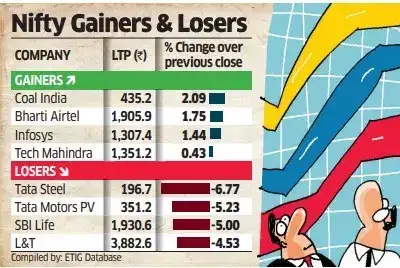 Agencies
 Near-term Reversal Bleak
“The US-Iran war is a major trigger, and the market sentiment is expected to remain cautious till there is stability/ ceasefire-and it is not stable yet,” said Lakshmi Iyer, group president and CEO, Bajaj Alternates.
Further downside could be possible before markets stabilise as near-term disruptions are likely, given the spike in crude oil prices, she said.
So far in March, Brent crude futures have shot up nearly 14% with the prolonged closure of the Strait of Hormuz-a key transit route off Iran’s coast used to transport oil and gas-expected to drive prices to $100 a barrel. The halt of liquefied natural gas (LNG) production by Qatar after Iranian attacks has resulted in prices surging, hurting sentiment.
India’s volatility index soared over 20% on Wednesday to 21.1, indicating traders anticipate high risks in the market in the near term. Over the past two sessions, VIX shot up by close to 50%. Technical indicators are far from flashing a near-term reversal, said analysts.
“The sharp uptick in VIX in the last couple of sessions indicates that deeper cuts are likely in the near term,” said Ajit Mishra, SVP, research, Religare Broking. “The Nifty has already breached the crucial level of 24,600 in the previous session, which implies the possibility of further downside till the 24,050 levels.”