

And while the fans, and Starfleet members like Beckett Mariner are obsessed with the adventures of Captain Kirk, some divisions, like the Department of Temporal Investigations, would be much happier if Kirk would stop being so rebellious and stick to the rules. And, as seen on Star Trek: Deep Space Nine, there’s good reason for some agents to speak Kirk’s name with anger.
Captain Kirk Has A Record That No One In Starfleet Is Trying To Break
In the classic Deep Space Nine episode “Trials and Tribble-ations” Captain Sisko, Worf, Jadzia Dax, Odod, Chief O’Brien, and Dr. Bashir find themselves accidentally sent back in time and end up on Kirk’s Enterprise. Not only that, they have ended up arriving on Stardate 4523.7, the same day as one of the most celebrated Original Series episodes, “The Trouble with Tribbles.”
Throughout the episode, the DS9 crew blends in with scenes from “The Trouble with Tribbles” and give viewers insight to moments that had previously gone unseen, including why tribbles continue to fall on Kirk after he has opened the cargo door (Dax and Sisko are hiding in the hold and tossing tribbles out!).
Fans also learn that Sisko’s favorite Kirk story is his fight with the Gorn, and for the first time ever, get a hint that something happened to Klingons that explains why the Original Series versions look so different from what would become the common design of the famous alien race, but Worf doesn’t want to get into it.
“Trials and Tribble-ations” was part of a celebration of the 30th anniversary of Star Trek (which happens to have been 30 years ago this year, so if you watched it when it originally aired, you are officially old. Congratulations!). And while the episode was meant as little more than a fun way to recall a great Original Series episode, it also dug into a monumental record Captain Kirk holds. And it isn’t a good one.
Why Captain Kirk’s Tombstone Said “James R. Kirk” In Star Trek Season 1
Star Trek’s second pilot, “Where No Man Has Gone Before,” gives Captain James T. Kirk the erroneous middle initial of R on his tombstone.
“Trials and Tribble-ations” itself is an episode where the adventure is being told to someone else. In this case it is Captain Sisko explaining what happened to two agents from the Department of Temporal Investigations. As the name suggests, this division of the Federation government investigates time travel events, and no one has kept them as busy as Captain Kirk.
Upon learning that Sisko’s journey to the past involved Kirk, the two agents are noticeably annoyed and reveal to DS9’s leader that the Kirk alone is responsible for 17 temporal violations. More than anyone else by a large margin.
We Still Haven’t Seen All Of Kirk’s Temporal Violations
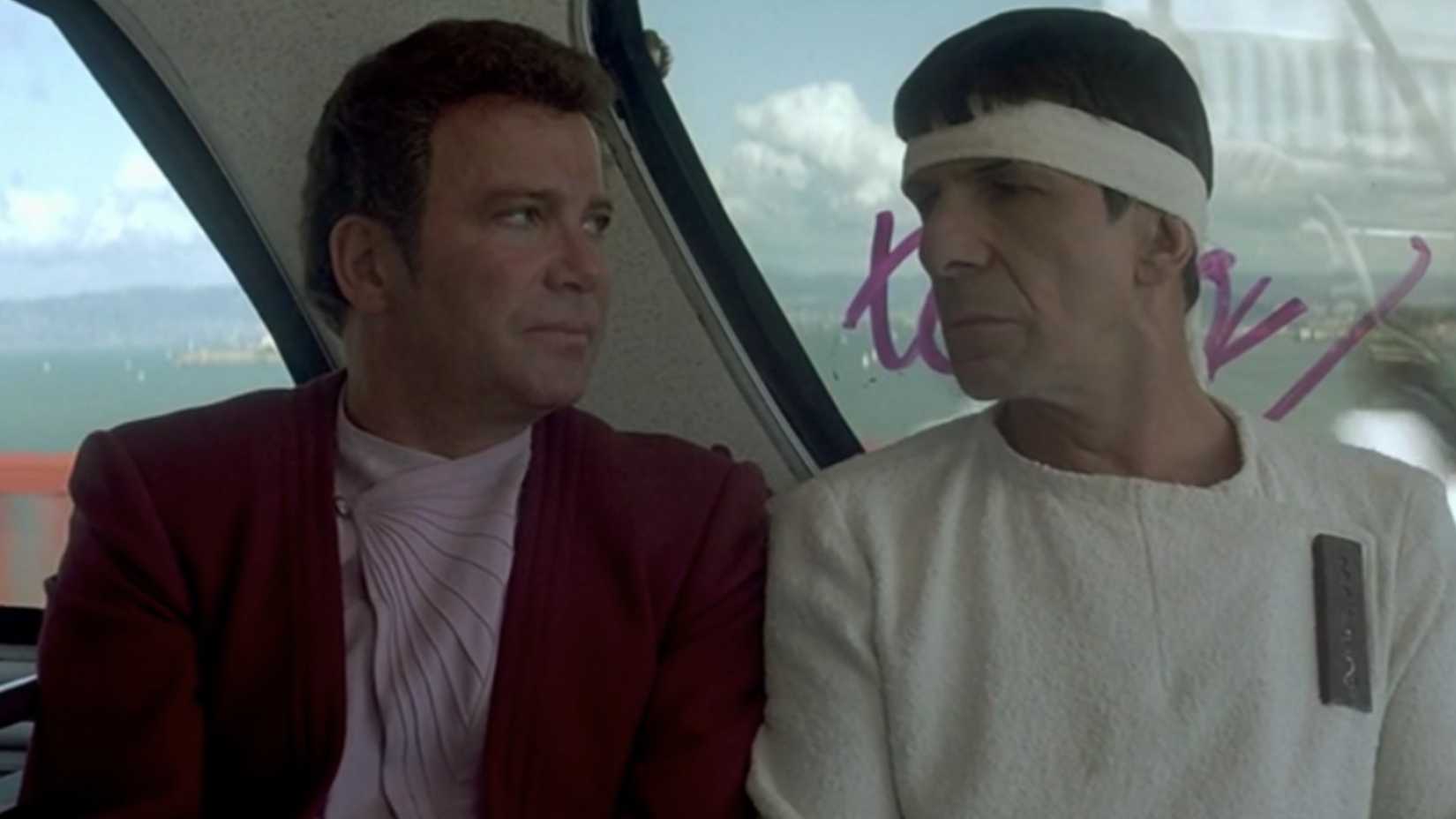
While Captain Kirk’s temporal violations are not laid out in “Trials and Tribble-ations,” fans have had 30 years to piece together what they may be, and only a few of the events have been shown in the shows and movies.
The first event is in “The Naked Time” where Kirk essentially invents time travel when he orders Mister Scott to do a full-power restart of the warp engines by mixing matter and anitmatter, sending the Enterprise back 71 hours.
The next time Kirk messes with the timestream is “Tomorrow Is Yesterday,” where the Enterprise finds itself in the 1960s due to the effects of a “high-gravity black star” and is detected by the United States military. Kirk then decides to kidnap an Air Force pilot, only to learn that the pilot’s unborn child will be part of the first mission to Saturn. Kirk decides to return the pilot, but not before the crew can get into some hijinks.
This episode also sets up the idea of traveling through time by slingshotting around the sun, a method that Kirk and the crew would later use in Star Trek IV: The Voyage Home when they travel to the 1980s to find whales (and again mess with the timestream).
Perhaps the most monumental episode of the Original Series, “City on the Edge of Forever” sees Kirk, Spock, and McCoy end up in 1930 and almost change history so that the Nazis would win World War II. Next came “Assignment: Earth” where the crew of the Enterprise travel to 1968 for “historical research” and meet the Doctor Who knock-off Gary 7.
In the Star Trek: The Animated Series episode “Yesteryear,” Kirk and Spock return from another “time travel research project” using the Guardian of Forever from “City on the Edge of Forever” only to realize that the timeline has been disrupted and Spock has been replaced by an Andorian.
In this new timeline, Spock died when he was 7. In the original timeline, Spock almost died, but was saved by his uncle, Selek, who, it turns out, was actually a time-traveling Spock. Spock then has to travel back in time again to make sure he doesn’t die. How this time paradox came to be is surely one of the things the Department of Temporal Investigations has questions about.
After that, the next time travel adventure fans would see Kirk be part of was Star Trek IV. There are other stories from novels, like Elusive Salvation and From History’s Shadow that, depending on which fans you talk to, should or should not be counted.
And then there is the ultimate question: do agents of the Department of Temporal Investigations know of any events from the future? For example, at the time of “Trials and Tribble-ations,” the universe believes that Kirk is dead, but Star Trek: Generations would later reveal that Kirk was living outside of normal space-time and would come back to save the day.
And even then, are all of these moments violations? If Kirk was told to travel to the 1960s to research the past, can that be held against him? Of course, considering the Federation and Starfleet’s stance on time travel, it does seem odd that they would be sending crews through time, as that would almost certainly go against the Temporal Prime Directive.
Whatever the case, what is known is that Captain Kirk messed with the timestream more than anyone else, and the Department of Temporal Investigations is not a fan of his work.
- Created by
-
Gene Roddenberry
- First Episode Air Date
-
September 8, 1966
- Cast
-
William Shatner, Leonard Nimoy, George Takei, Nichelle Nichols, Deforest Kelley, James Doohan, Walter Koenig, Jonathan Frakes, Patrick Stewart, Michael Dorn, Marina Sirtis, Gates McFadden, Brent Spiner, LeVar Burton, Wil Wheaton, Avery Brooks, Nana Visitor, Rene Auberjonois, Alexander Siddig, Cirroc Lofton, Armin Shimerman, Colm Meaney, Terry Farrell, Kate Mulgrew, Robert Beltran, Roxann Dawson, Jeri Ryan, Robert Duncan McNeill, Robert Picardo, Ethan Phillips, Garrett Wang, Jolene Blalock, Connor Trinneer, Dominic Keating, Scott Bakula, Linda Park, John Billingsley, Anthony Montgomery, Chris Pine, Zachary Quinto, Simon Pegg, Zoe Saldana, Karl Urban, John Cho, Chris Hemsworth, Benedict Cumberbatch, Anton Yelchin, Idris Elba, Sonequa Martin-Green, Mary Wiseman, Doug Jones, Anthony Rapp, Wilson Cruz, Oyin Oladejo, Emily Coutts, Jess Bush, Christina Chong, Anson Mount, Ethan Peck, Rebecca Romijn, Michelle Yeoh
- TV Show(s)
-
Star Trek: The Original Series, Star Trek: The Animated Series, Star Trek: The Next Generation, Star Trek: Deep Space Nine, Star Trek: Voyager, Star Trek: Enterprise, Star Trek: Discovery, Star Trek: Short Treks, Star Trek: Picard, Star Trek Lower Decks, Star Trek: Prodigy, Star Trek: Strange New Worlds, Star Trek: Starfleet Academy